Our Models
Turbulence Index
A regime diagnostic built on 17 years of live operation. When markets shift from normal to systemic stress, the Index identifies the transition before volatility
and price-based indicators reflect it.

What it is
What is the Turbulence Index?
The Turbulence Index gives you one clear read: whether financial markets are behaving normally, or under systemic stress.
When it enters turbulent territory, diversification breaks down. Correlations spike. That is the moment to adjust: reduce risk exposure, increase hedges, add convexity.
When it returns to calm, the signal supports re-entering standard risk-on positioning. No guesswork.
Live since 2008. Tested through the Global Financial Crisis, COVID, and the April 2025 tariff shock. Failures documented alongside successes.
Live since 2008
Not a backtest. A framework that has operated through every major market stress episode of the last 17 years.
13 asset classes, one regime signal
Measures joint behaviour across equities, rates, credit, and currencies, catching stress that emerges through correlation, not just price.
Act before volatility catches up
The Index detects structural anomalies before they propagate into prices and implied volatility. You see the regime shift first.
Availability and coverage
Regular Turbulence Index readings focus on the S&P500 but the supesets als provide insigth for the specific asset classes. Markets and integratesd within our broader state-of-the-market and risk monitoring frameworks.
Why It Matters
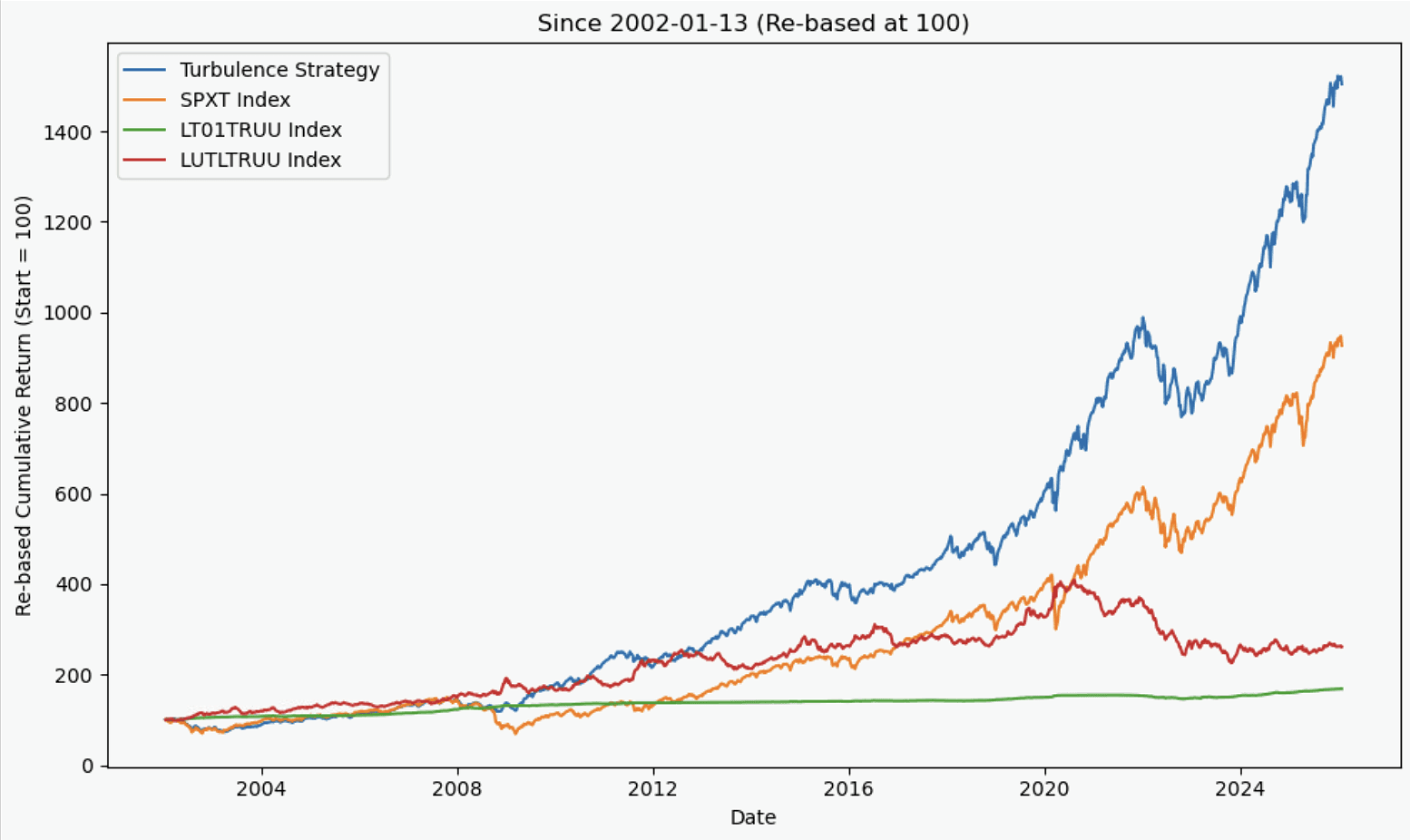
Highlighting systemic stress before market reactions
Turbulence Index Strategies (i.e. TI):
Q1 2026: TI 4% vs S&P500 2.9%
2008: TI −0.06% vs S&P500 −51.5%
2020: TI +27% vs S&P500 +15.3%
Fragility before the drawdown
Know when markets are pricing risk as a single correlated block, before damage compounds.
A concrete action, not just a reading
Turbulent: reduce risk, add hedges. Normal: standard positioning supported. Signal translates directly to portfolio behaviour.
A process you can defend
Every signal documented, version-controlled, traceable to academic source.
Market Insights
Selected research notes on macro regimes, risk dynamics, and portfolio implications across market cycles.