Published on May 19, 2026
The Central Bank Trap: When Every Option Is the Wrong One
Federico Polese

Trade routes, capital flows, monetary regimes. The fracture was not cyclical. It was architectural.
Central banks are now operating inside that architecture. And the room available to them is narrower than the policy rate alone suggests.
Two constraints, not one
The standard framework for central bank policy treats inflation and growth as a trade-off. Raise rates to cool prices. Cut rates to support activity. The problem is that this framework assumes the dominant source of inflation is domestic demand. In a stagflationary regime, that assumption does not hold.
Supply shocks push prices higher while simultaneously generating a negative economic impact. That is not a demand problem. Rate hikes may address the symptom, but they also deepen the growth damage. The Fed and the ECB are not facing the same version of this problem. Their constraints are structurally different.
The Fed’s constraint is fiscal
Gross Treasury issuance has risen sharply over the past decade, driven by both expanding deficits and the need to refinance a growing stock of maturing debt. What matters for monetary transmission is not just the net deficit figure. It is the fact that markets must continuously absorb a larger stock of duration, even when net borrowing is much smaller than gross auction volumes.
David Beckworth, writing in Macroeconomic Policy Nexus , has been tracking the growing interaction between fiscal policy, Treasury supply, and monetary transmission. The issue is not necessarily full fiscal dominance, but a gradual narrowing of the Fed’s effective room to maneuver.
The consequence is visible in the structure of the yield curve. Even if the Fed eases its policy rate, the long end may remain less responsive than in past cycles. Persistent deficits and large refinancing needs run against monetary restraint. The link between the policy rate and the long end has become less reliable.
This is not a loss of central bank independence. But it is a meaningful fiscal constraint on monetary transmission: rate cuts deliver less stimulus than the same cuts would have in a world of smaller Treasury supply and lower term premiums.
The ECB’s constraint is external
The ECB entered this period in a different position. Domestic inflation had been moderating. Wage growth was decelerating. Underlying inflation pressures had been easing, even if not fully normalised.
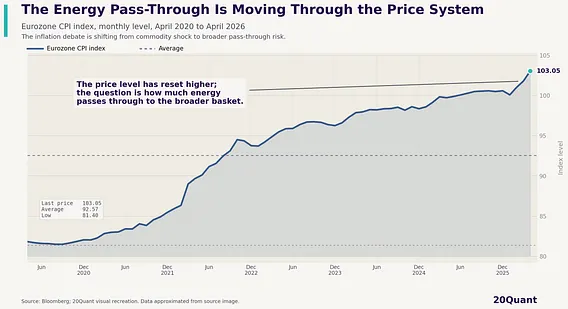
The risk the ECB now faces arrives from outside the euro area. Ayesha Tariq, CFA, writing in MacroVisor, frames the broader near-term distinction clearly: an energy-driven inflation impulse is different from a domestically generated demand cycle, and that distinction matters enormously for how central banks can respond. A shock transmitted through commodity prices, exchange rate pass-through, and disrupted supply routes creates a situation where inflation rises while real incomes fall and growth slows.
That is not a scenario where aggressive tightening resolves the problem. Tightening would not fix an external supply shock. It would simply add a domestic demand headwind to an already negative external impulse.
The ECB’s reaction function in this environment argues for caution, not necessarily for the aggressive tightening that market pricing at certain points has implied. The central question is whether the shock remains primarily in energy and food, or whether it feeds into wages and services through second-round effects. Until that distinction is clear, the ECB has limited room to act decisively in either direction.
This is the trap. Not a policy error, but a structural condition. The monetary instrument is not well designed to respond to a shock that originates in geopolitics, geography, and supply routes.
The structural asymmetry
Both institutions are constrained, but by different forces.
The Fed is constrained by its own government’s balance sheet. The long end of the curve partially reflects this tension. Cuts provide less stimulus than they did in previous cycles.
The ECB is constrained by geography and the external environment. Inflation is not primarily a function of excess domestic demand. It arrives through energy prices, FX, and exposure to shocks that monetary policy cannot directly address.
The lesson from the 2022 episode is relevant here. When fiscal support is extended broadly across the income distribution rather than targeted at the most vulnerable, it sustains demand that firms can use to pass on higher costs. That forces monetary policy to tighten more than it otherwise would. The calibration of any fiscal response to an external shock matters as much as the monetary response.
What this means for the regime
The fragmentation we described is now visible in the structure of policy itself.
Two major central banks, facing different variants of stagflationary pressure, are operating with reduced room to use conventional tools in the conventional direction. One is partially constrained by its government’s financing needs. The other by external shocks it has no control over.
As Claudia Sahm noted in Stay-At-Home Macro (SAHM), the Fed’s own projections have at times pointed to an uncomfortable mix of risks: inflation above target, growth under pressure, and unemployment moving higher. That is precisely the kind of configuration in which the standard policy reaction function becomes harder to apply.
The diagnostic question is not which central bank will move rates next quarter. It is whether the framework built for the disinflationary cycle of 2009 to 2021 is adequate for a world where inflation is structural, fiscal, and geopolitical in origin.
In that world, the standard reflexes do not work as expected. Growth can weaken while long-term yields stay elevated. Central banks can want to ease and still face constraints on how much the long end follows. Portfolios built on the assumption that bonds rescue growth shocks may behave differently than the historical data suggests.
The regime has shifted. The frameworks are adjusting slowly.