Published on Jun 4, 2026
The macroeconomic scenario in the Eurozone and Italy has darkened over the last month
Federico Polese
The initial "wait-and-see" approach from central banks has expired, and Italy is facing acute structural and fiscal pressures.
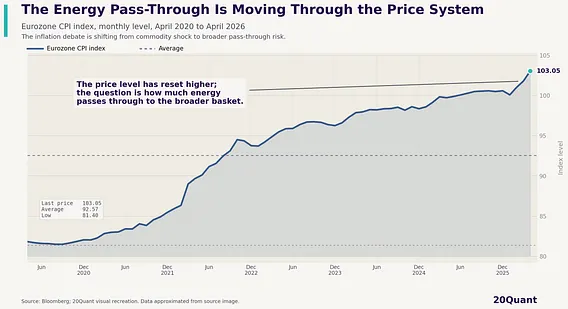
1. Eurozone Inflation: “Down Like a Feather, Up Like a Rocket” The hope that the Middle East energy shock would remain contained has evaporated. Eurozone HICP inflation rose to a disappointing 3.2% year-over-year in May. Crucially, inflation is no longer isolated to energy; the pass-through to the broader economy is happening much faster than it did in 2022. Seasonally adjusted data confirms that services and non-energy industrial goods inflation are decisively pointing north. Because the memory of the 2022 inflation spike is so fresh, companies are raising prices and workers are demanding higher wages much earlier in the cycle.
2. The ECB’s Accelerated Tightening Path The ECB can no longer claim the shock is temporary. The central bank is now expected to launch a rapid, front-loaded tightening cycle to prevent inflation expectations from de-anchoring.
The Path: Following a highly probable initial 25-basis-point hike on June 11, the ECB will likely shift gears, potentially delivering 50-basis-point hikes in July and September, followed by a final 25-basis-point increase in December.
Terminal Rate: This aggressive trajectory would push the ECB deposit rate to 3.50% by year-end, with inflation projected to peak near 4.5% to 5.0%.
3. Eurozone GDP: A Q2 Contraction Risk The energy shock has rapidly morphed into a demand shock. While manufacturing PMIs showed a brief, temporary illusion of resilience driven by defensive supply stockpiling, the services sector and consumer confidence have collapsed. The Eurozone economy is now bracing for a likely GDP contraction in the second quarter of 2026.
4. Italy’s Growth Reversion and Trade Deterioration Italy’s post-pandemic economic miracle is definitively over. The massive demand stimuli—specifically the National Recovery and Resilience Plan (NGEU) and the Superbonus—are exhausted, leaving the economy to revert to a meager ~0.5% growth pace. Compounding the growth slowdown is a severe deterioration in trade. Italy’s trade deficit with China has widened sharply, and its energy trade balance is expected to worsen significantly as the oil and gas shock takes its toll. Furthermore, domestic demand for durable goods, such as car registrations, remains notably weak.
5. Italy’s Fiscal Reality: The 149% Debt Trajectory Public finances remain the primary vulnerability. While Italy achieved a minor deficit reduction to 3.1% in 2025, it missed the target required to exit the EU’s Excessive Deficit Procedure. The underlying dynamics are alarming:
Debt Surge: The European Commission’s Debt Sustainability Analysis (DSA) projects Italy’s debt-to-GDP ratio will surge to an extreme 149.1% by 2026.
Tax Burden: The overall tax burden has increased sharply as a lagged effect of inflation.
Consolidation by Stealth is Over: In the past, the lack of wage adjustments to higher inflation made fiscal consolidation politically easier. Moving forward, as the economy stagnates and inflation bites, spending restraint will become much more challenging without deep structural reforms.
6. EU Fiscal Flexibility: A Minor Lifeline for Italy In the recent 2026 Spring Semester Package, the European Commission offered a slight reprieve. Member states taking action to strengthen energy security and transition away from fossil fuels can now request limited fiscal flexibility under the National Escape Clause for defense spending. This allows for a dedicated annual cap of 0.3% of GDP (and a cumulative cap of 0.6% for 2026-2028) specifically for energy resilience measures, giving Italy a small buffer to manage the current shock.
7. The Credit Collapse vs. Household Hoarding The internal financial cycle in Italy shows a staggering divergence. Bank lending to non-financial corporations (NFCs) is experiencing a severe downturn, reflecting a complete lack of corporate appetite for risk. Conversely, Italian households continue to hoard massive amounts of liquidity, holding roughly €1,250 billion in bank deposits, as economic uncertainty drives the propensity to save higher and keeps consumption suppressed.
8. Political Pressures on PM Meloni Domestically, Prime Minister Giorgia Meloni’s political mandate is facing severe tests ahead of the 2027 elections. The government recently suffered a defeat in a justice referendum. Furthermore, Meloni’s political alignment with US President Donald Trump has become deeply unpopular in Italy, especially given the escalating Middle East conflict and Italy’s pacifist leanings. To survive, Meloni is expected to execute a foreign policy pivot back toward Europe and may be forced to reshuffle her cabinet to marginalize coalition members who are damaging the government’s credibility.