Published on May 21, 2026
The Energy Pass-Through: What the Data Is Actually Saying
Federico Polese
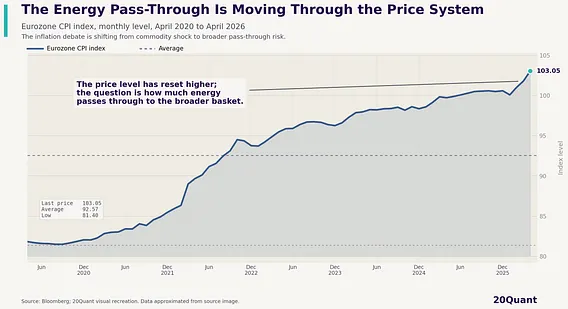
Only a few months earlier, the energy component was still negative. By April, it had moved to +10.8%.
That kind of move tells us something important: the shock is no longer sitting only in commodity markets. It is starting to move through the price system.
Most of the acceleration is still coming from energy. The ex-energy measure held at 2.2%, while services remained broadly stable at 3.0%. Non-energy goods rose to 3.1%, from 0.4% in January, which suggests that transport, packaging and input costs are beginning to pass through supply chains.
So far, underlying inflation has not broken. But the shock sitting on top of it has become larger, faster and harder for the ECB to ignore.
The same tension is now visible in the US, although from a stronger starting point. The April FOMC minutes showed total PCE inflation estimated at 3.5% in March and core PCE at 3.2%. Fed participants noted that higher fuel prices were already affecting shipping costs, airfares and other categories. They also saw inflation risks tilted to the upside, while employment and growth risks were tilted to the downside.
That is the uncomfortable part.
The economy does not need to be in 1970s-style stagflation for policymakers to face a stagflationary trade-off.
Rate hikes can cool demand. They cannot produce oil, refill gas storage, or reopen disrupted supply routes. Tightening into an energy shock risks adding a domestic slowdown to an external shock that is already hurting real incomes.
But patience has limits. If higher energy prices start feeding into wages, services inflation or inflation expectations, central banks lose the ability to simply look through the shock.
The US and Europe are also not facing the same problem.
The US still has stronger growth, supported by resilient consumption and AI-related investment. Europe is more exposed to imported energy and weaker domestic demand. That leaves the Eurozone closer to the kind of setup that creates difficult choices for the ECB.
For portfolios, the distinction matters.
When inflation is the problem, bonds do not always hedge equities in the way investors expect. The traditional 60/40 portfolio becomes more fragile because higher inflation can push stock-bond correlations higher.
The question is no longer simply how defensive a portfolio is.
It is what kind of resilience it owns.
In a stagflationary configuration, our factor framework tilts away from growth and short-term reversal, and toward profitability, balance-sheet strength and earnings quality. The market would not simply be buying defensiveness. It would be paying for resilience.
The same logic applies across asset classes. Real assets, infrastructure, energy-linked cash flows, gold and liquid alternatives can play a different role from traditional duration. Within equities, broad beta becomes less useful. Investors need to separate structurally supported growth, such as AI infrastructure and cloud capacity, from cyclicals exposed to tariffs, input costs and weaker consumers.
Three things matter from here:
services inflation, energy pass-through and the ex-energy inflation trend.
Neither the Eurozone nor the US is formally in stagflation today. But both are moving toward a regime where central banks and portfolios have fewer easy choices.
The data that will resolve the debate has not arrived yet.