From Silicon to Glass: The New Bottleneck in AI Infrastructure
Riccardo Alberti
A weekly institutional brief on how the AI infrastructure trade is moving beyond chips and into the physical bottlenecks behind data-center growth: optical fiber, connectivity, power cables, pricing power and valuation risk.

Executive Summary
Fujikura's 47% operating profit guidance upgrade confirms that the AI infrastructure bottleneck has moved from semiconductors to optical connectivity. Hyperscalers are locking in multibillion-dollar, multiyear fiber supply agreements with Corning, and lead times have stretched to 12-24 months. New preform capacity takes two years to come online; greenfield fiber manufacturing takes four. The constraint is structural.
Prysmian is the preferred European expression of the theme: fiber, power cables and grid infrastructure at 32.3x NTM earnings, the lowest multiple among pure-play exposures. The basket spans Fujikura, Corning, Nexans, Coherent and Furukawa Electric.
The Turbulence Index has returned to Quiet. A DeMark sell setup is active on the daily S&P 500 but remains early, with six of thirteen bars recorded.
01 The AI Capex Cycle Moves Downstream
Where the constraint frontier is shifting
The AI infrastructure trade has moved past its first-order phase. The constraint frontier has reached optical connectivity: fiber, cables and physical interconnects that the market spent years treating as commodity infrastructure.
Fujikura raised its FY2027 operating profit guidance to ¥310 billion from ¥211 billion on June 18, citing hyperscaler orders for optical components not included in the original forecast. The stock hit limit up. Morgan Stanley called the magnitude of the revision unusual, barely a month after the previous full-year results.
Amazon, Meta and Nvidia have collectively committed over $10 billion in multiyear supply agreements with Corning since January. Corning's optical communications revenue rose 36% year on year in Q1 2026, and fiber-cable lead times have stretched to roughly a year, with analysts expecting tightness to persist into 2027.
The question is whether optical infrastructure is entering a durable pricing-power cycle, or repricing temporarily on AI sentiment ahead of earnings delivery.
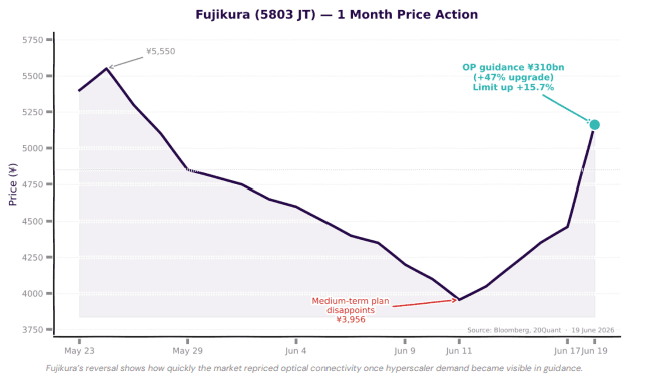
Fujikura’s reversal shows how quickly the market repriced optical connectivity once hyperscaler demand became visible in guidance.
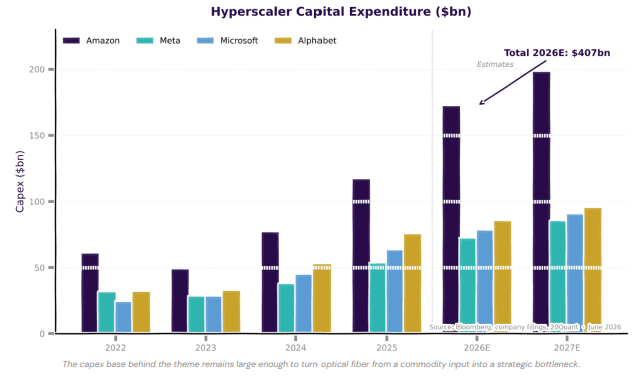
The capex base behind the theme remains large enough to turn optical fiber from a commodity input into a strategic bottleneck.
02 Stocks of the Week
The glass layer of AI infrastructure
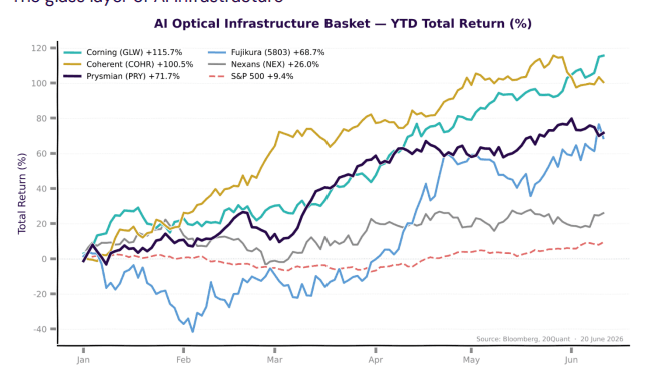
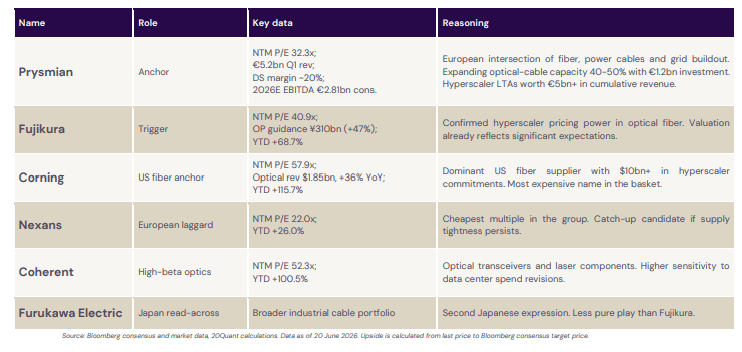
The 20Quant GSY Crash Risk Monitor adds a layer of discipline to the selection. Communications Equipment has emerged as the clearest fresh spillover signal in the current reading, reflecting the migration of the AI trade into networking, optical connectivity and the physical layer of the buildout.
The signal does not invalidate the bottleneck thesis, but it confirms that the cohort is now crowded enough to warrant selectivity. Owning the theme broadly is no longer sufficient; the premium belongs to the names where backlog visibility and relative valuation still overlap.
Stocks of the week
The exposure this week is Prysmian, trading at 32.3x NTM earnings against Fujikura at 40.9x, Coherent at 52.3x and Corning at 57.9x. Prysmian offers fiber demand, power cable backlog and grid infrastructure in a single name at the lowest multiple among the pure-play exposures in the basket, with the strongest earnings visibility: the company is investing €1.2 billion to expand optical-cable capacity by 40-50% and has initiated long-term agreements with hyperscalers expected to generate over €5 billion in cumulative revenue.
The bull case rests on duration: hyperscaler supply agreements, transmission backlogs and grid modernisation programmes extend years forward. The bear case is simpler: peak-cycle multiples on what looks structural but could prove sensitive to any deceleration in AI capex.
03 Turbulence Index
Measuring stress beneath the surface
The Turbulence Index is a cross-asset stress indicator based on Mahalanobis distance across thirteen asset classes. It measures whether market structure is orderly or whether correlations are drifting from historical norms.
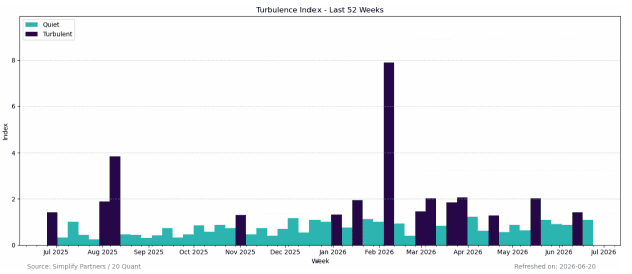
Current regime: Quiet
The index has returned to Quiet after signalling elevated stress last week. The S&P 500 closed at 7,635, flat on the week, absorbing the Fed's hawkish messaging without damage.
The return to Quiet suggests cross-asset relationships have stabilised, with the current backdrop more supportive for thematic positions.
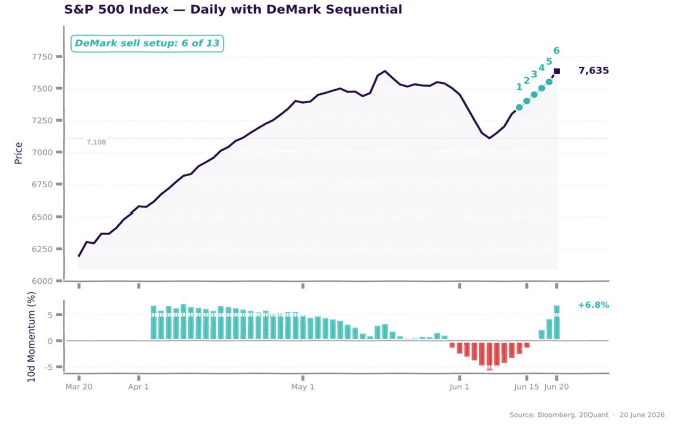
A DeMark sell setup countdown has begun on the daily chart with six bars recorded, well short of the thirteen required for a perfected signal. Momentum has turned negative but price remains near the highs. Worth monitoring, not acting on.
What this means for the theme
A Quiet regime supports the optical infrastructure trade. The specific risk sits beneath the surface: the entire fiber and cable cohort trades on multiyear hyperscaler capex commitments. A regime shift to Turbulent would compress willingness to pay for that duration, hitting long-backlog names like Prysmian and Corning harder than the broader market.
04 Wrap-Up: Next Week
What to watch next week
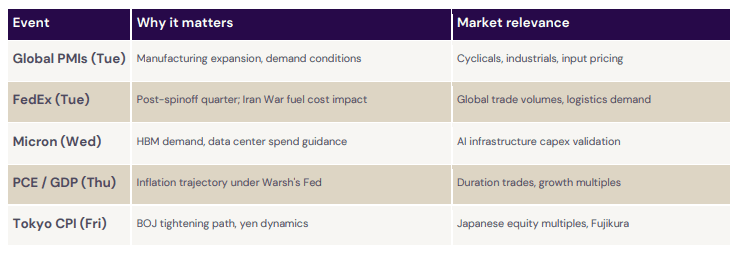
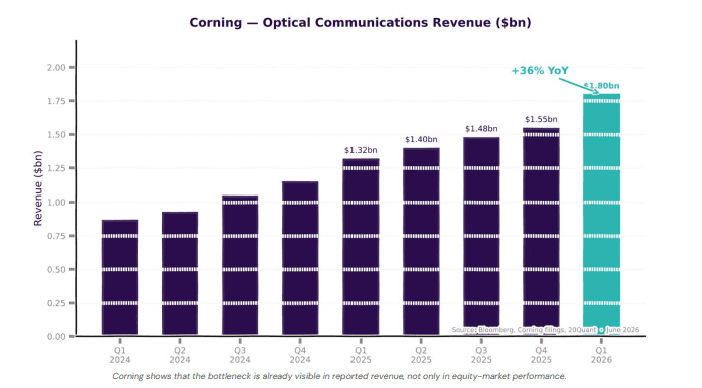
Corning shows that the bottleneck is already visible in reported revenue, not only in equity-market performance.
Micron: the capex check
Micron's HBM guidance is the most direct read-across. If data center spend accelerates, infrastructure constraints keep migrating downstream. A soft outlook questions the durability of the second-order supply chain trade.
PCE and the duration bet
Warsh's first meeting raised the possibility of a rate hike. Tighter financial conditions compress the multiples on companies whose earnings are years away from fully reflecting current demand.
Tokyo CPI
A hotter print accelerates BOJ tightening expectations, pressuring the multiple on Fujikura at around 41x regardless of underlying demand.
05 Closing
In brief
We would be long the optical infrastructure theme through Prysmian as the primary European expression, Corning as the US anchor and Fujikura as the confirming trigger. The majority of the thematic exposure belongs in Prysmian, with satellite positions in Corning and Fujikura sized to reflect their higher valuation risk.
Pricing power in fiber and optical connectivity reflects genuine physical scarcity: global fiber demand is forecast at 577 million core-km in 2026 against supply growing less than 3%, and new manufacturing capacity cannot arrive before 2028. Hyperscalers do not sign multibillion-dollar multiyear supply agreements for products they can easily source elsewhere.
Two triggers would change this view. First, a meaningful reduction in hyperscaler capex guidance during the next earnings cycle. Second, a normalisation of fiber-cable lead times below six months, which would signal that the supply constraint is cyclical rather than structural.
Micron on Wednesday is the first test. If the compute layer is still pulling demand forward, the glass layer behind it has further to run.
Market Insights
Selected research notes on macro regimes, risk dynamics, and portfolio implications across market cycles.