Published on Jul 7, 2026
The Datacentre Buildout
Federico Polese
Executive Summary
Compute is committed. The returns now sit in the constraints.
The AI datacentre buildout has stopped being a demand story. The capital is committed. The question that pays is which layer of the supply chain captures the spending, and how much an investor should pay for access to it.
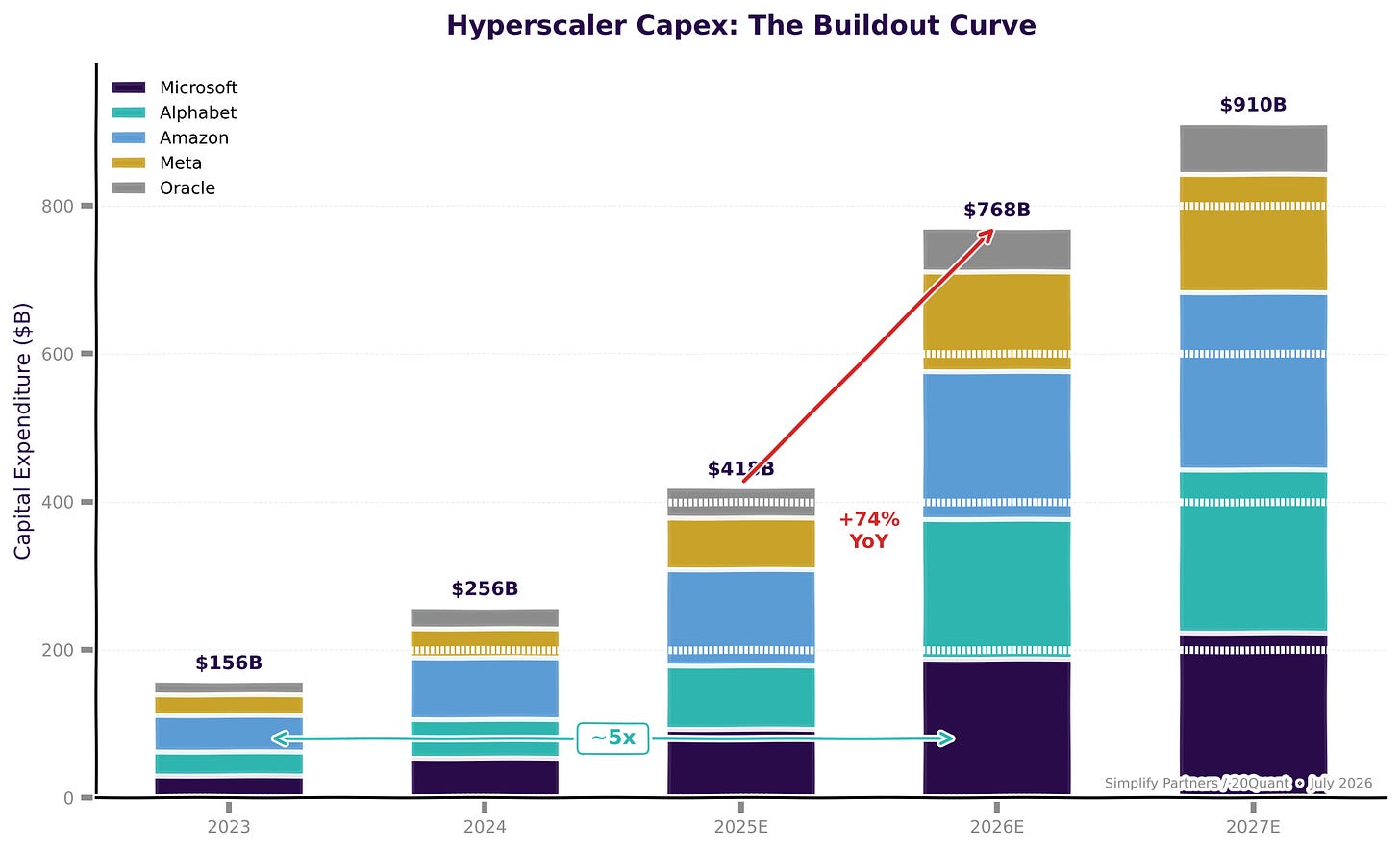
Combined hyperscaler capital expenditure is set to reach roughly $770 billion in 2026, a 74 percent increase on the prior year and close to five times the $156 billion deployed in 2023. Spending on that scale, contracted years ahead, converts the story from demand into delivery. The binding constraints are now physical: custom silicon, firm power, and the metals and equipment that carry electricity to the rack.
Position for the constraint, not the headline. The risk is the price of access, not the existence of demand.
David Cahn at Sequoia framed the demand side as a $600 billion question: whether AI revenue can justify the infrastructure being built around it. This note takes the other side of the same ledger. The spending is locked. The question is which physical layer captures it, and at what price.
The capex supercycle is now a delivery question
Demand visibility is no longer in doubt. The four largest spenders have each stepped their guidance up, and in most cases flagged a further increase into 2027.
Microsoft: 2026 capital spending guided to around $190 billion including finance leases, with roughly two thirds of first-quarter capital going to short-lived assets such as GPUs and CPUs rather than physical shells.
Alphabet / Google: 2026 guidance raised to $185 to $190 billion, with management explicitly noting that 2027 capital will increase significantly from that level.
Amazon: 2026 capital spending held at about $200 billion, a 56 percent year-on-year increase, with first-quarter cash capex of $43.2 billion.
Meta: 2026 guidance raised to about $135 billion from $125 billion, and a projected cumulative spend approaching $600 billion through 2028.
Oracle: 2026 capital of roughly $50 to $59 billion, with remaining performance obligations that have surged into the hundreds of billions.
Data Center Richness tracked the quarterly ramp as it happened: the Big Four alone plan up to $630 billion for 2026, about a 62 percent increase from the record $388 billion in 2025. The demand side is settled. What follows is a note about supply.
Silicon goes custom, and the value migrates
Hyperscalers are moving compute in-house to cut cost and, above all, power. The race is now performance per watt, and it is being won at the custom-silicon and connectivity layer rather than by the merchant GPU alone.
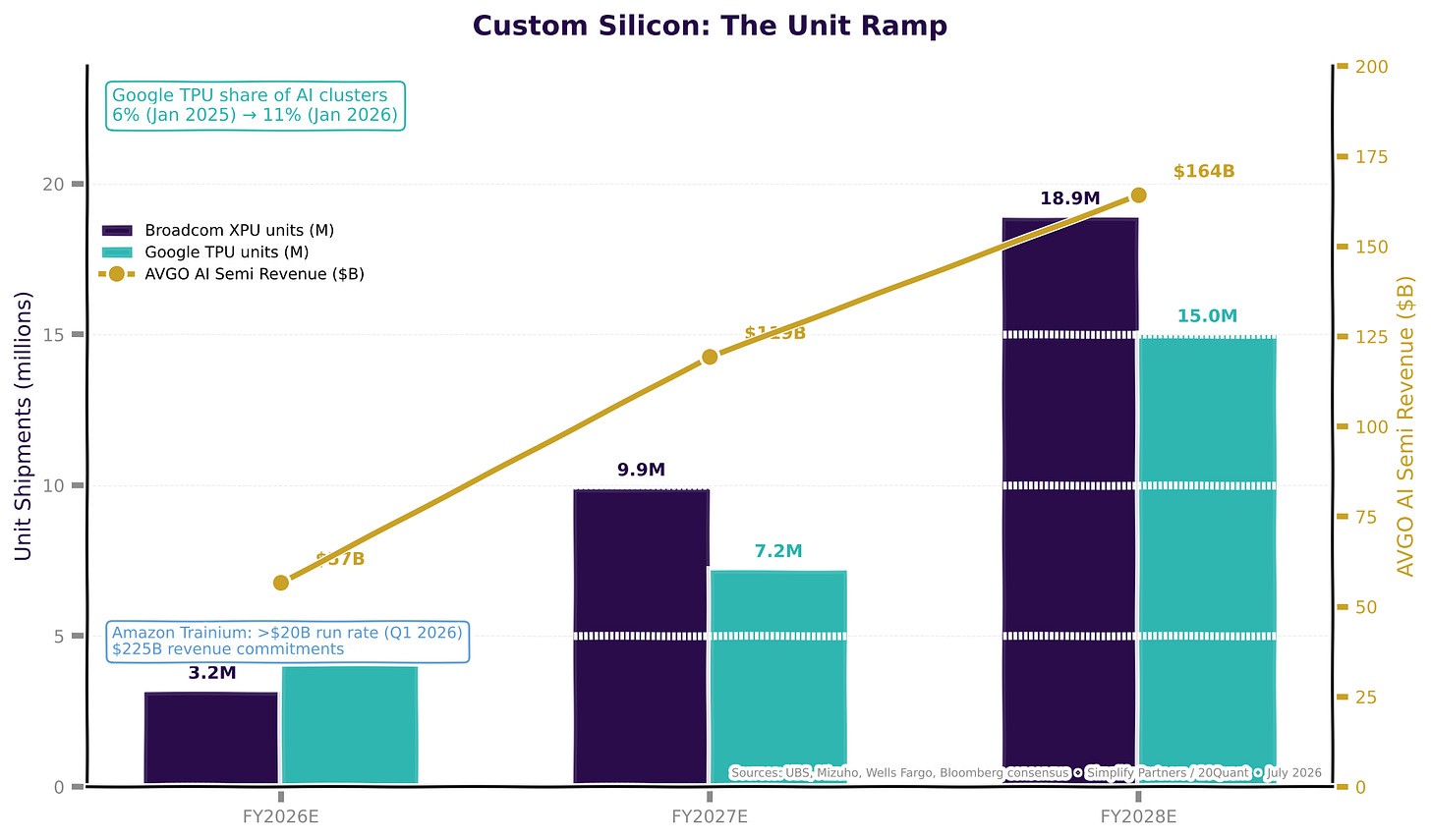
Google is scaling its own accelerators hard. TPU rack shipments are forecast at roughly 60,000 in 2026 and 105,000 in 2027, and the internal chip has lifted its share of AI cluster deployments from about 6 percent to 11 percent. Amazon is doing the same with Trainium and Inferentia, where custom-chip annual revenue is already above $20 billion and growing more than 100 percent, against reported revenue commitments of around $225 billion.
The named beneficiary is the design and interconnect layer. Broadcom carries the bulk of it: a 5 gigawatt custom-TPU partnership with Google, over 1 gigawatt of custom silicon with Meta, a reported OpenAI ASIC into late 2026, and accelerator unit sales forecast to rise from about 5.0 million in 2026 to 10.3 million by 2028. Around it sit the connectivity specialists.
Astera Labs: connectivity ramp tied to Amazon’s Trainium3, trading near 30 times bottom-up 2026 earnings estimates.
Marvell: custom-silicon partnership with AWS across the Trn2 and Trn3 accelerators.
Optical and cabling: Coherent and Lumentum into an optical-transceiver market forecast to grow roughly five times, from 45 million units in 2025 to 212 million by 2028; Corning on multi-billion fibre lockups with Amazon, Meta and Nvidia; Credo on the 1.6T active-electrical-cable ramp; Arista on back-end AI Ethernet growing at a 50 percent compound rate to $13.5 billion by 2029.
Merchant compute is necessary but increasingly commoditised relative to the bottlenecks around it. The margin is migrating to whoever solves power and connectivity. Hidden Market Gems has argued this point forcefully: GPUs are commoditising faster than the market expects, and the value is moving from compute to the physical constraints around it.
Power is the binding constraint of 2026
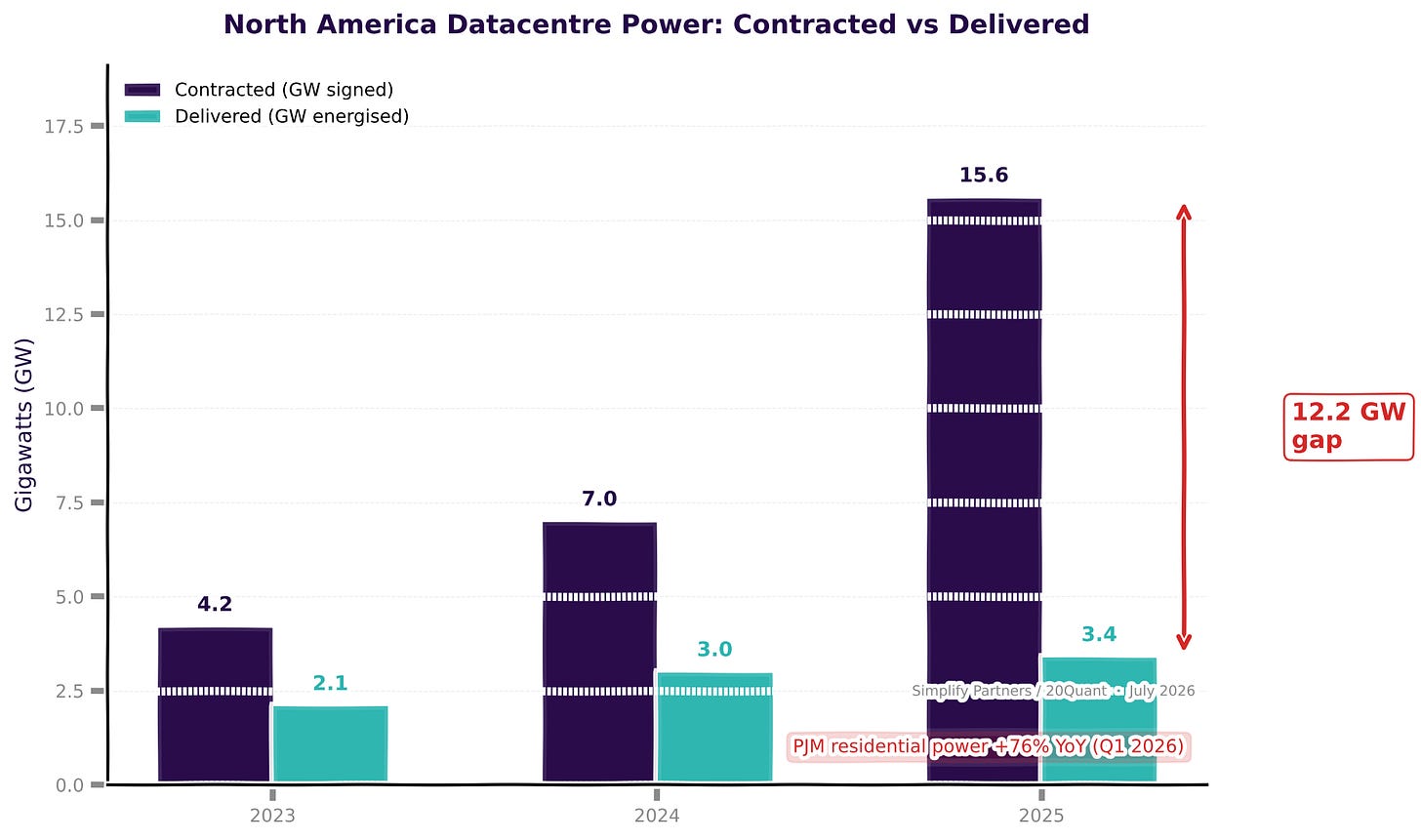
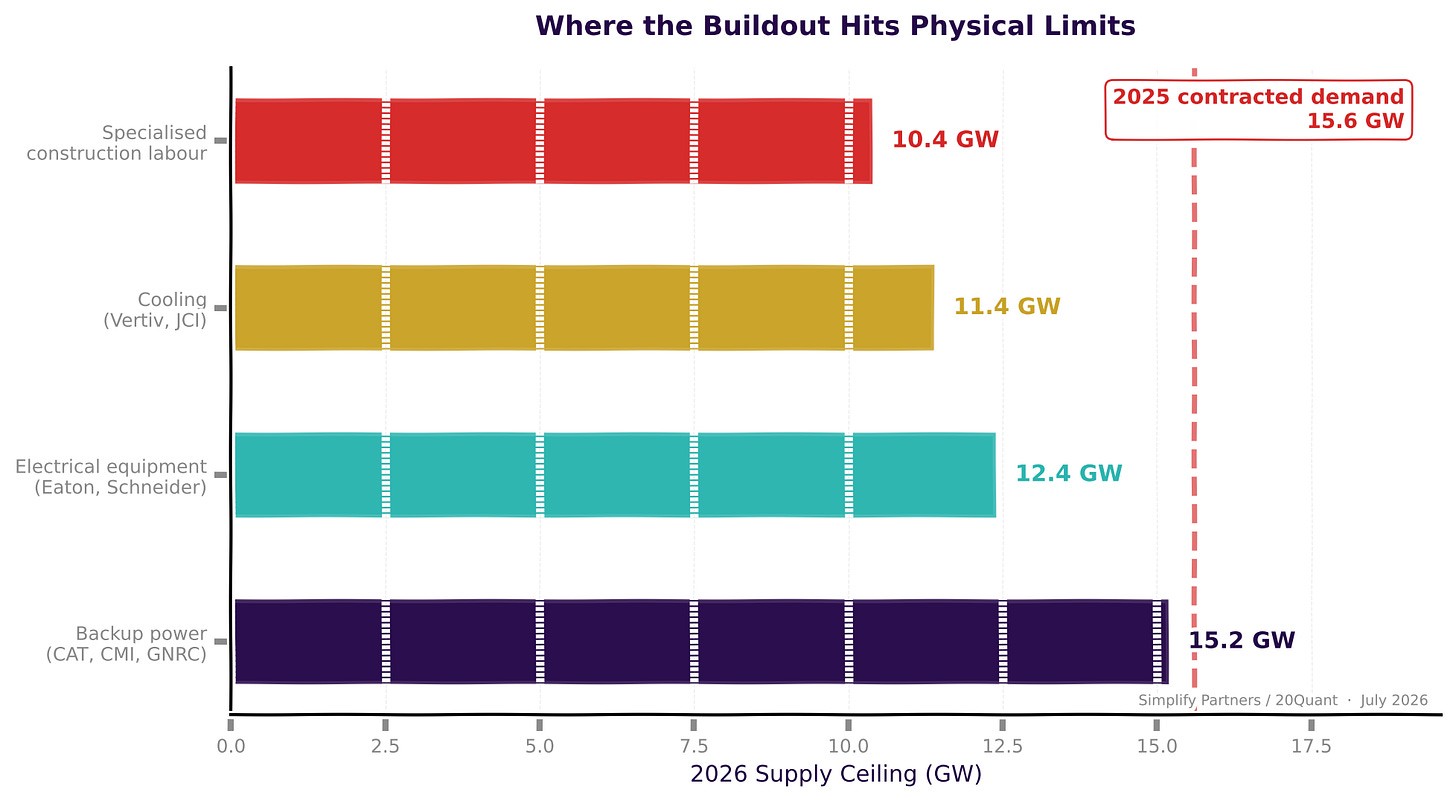
The gating factor for the year is electricity. North America signed 15.6 gigawatts of colocation leases in 2025 but delivered only 3.4 gigawatts, a 12.2 gigawatt gap between contracted demand and what the grid could energise. The price signal is already visible: PJM residential power prices rose 76 percent year on year in the first quarter of 2026.
Brian Sykes put it directly: the AI bottleneck is watts, not chips. JP Morgan estimates $1 trillion of US grid investment is needed over the next decade, but the constraint is time, not dollars. The average new transmission line takes more than ten years to build.
Where the grid cannot deliver, the buildout is routing around it. Energy Industry Insights from Avanza Energy documented this shift in detail: hyperscalers have assembled the largest private power infrastructure programme in US history, with every technology bucket now deploying at gigawatt scale simultaneously. Gas turbines are the dominant platform, with GE Vernova’s 100 GW backlog, but slots are sold out through 2027.
Access to firm power is becoming a competitive moat in its own right, and the beneficiaries are the companies that make and move electricity.
GE Vernova: supplier of long-lead gas turbines and transformers; booked $2.4 billion of data-centre equipment orders in a single quarter.
Eaton and Schneider Electric: the electrical-equipment layer, governing a hard 2026 deliverable ceiling of about 12.4 gigawatts.
NiSource: an Indiana-focused regulated utility using a dedicated generation structure to earn premium returns building power specifically for hyperscalers.
The same demand is pulling operators toward captive, behind-the-meter generation, including small modular nuclear where it can be secured. That is the constraint expressed as strategy.
The physical bill: copper and the materials floor
Electrification carries a materials cost. Copper is the enabler that sets the ceiling. Copper has run from just over $8,000 per tonne in early 2024 to more than $13,000, with analysts flagging a structural deficit that competes directly with the wider energy transition for the same metal.
Supply, not ambition, may set the ceiling. The datacentre buildout and the energy transition are bidding for the same tonne of copper.
The second-order layer: read the ceilings, not the hype
Beyond silicon and power sits a set of physical bottlenecks where demand is running ahead of a hard supply ceiling. These are the least glamorous and, on the evidence, among the clearest.
Cooling: Vertiv orders grew 71 percent year on year; Johnson Controls Americas orders rose 40 percent into a record $20 billion backlog, against a 2026 supply ceiling near 11.4 gigawatts.
Specialised construction labour: Primoris, EMCOR and Comfort Systems. Skilled labour is the binding constraint on the pace of buildout, capping 2026 expansion near 10.4 gigawatts. Data Center Richness tracked the supply chain response: Vertiv investing $50 million to expand manufacturing in Ohio, Crusoe building a $200 million modular AI factory plant in Colorado, GE Vernova opening a $105 million research centre in New York.
Backup power: Caterpillar, Cummins and Generac, the last of which secured a $600 million notice-to-proceed for 2027 deliveries, against a 15.2 gigawatt ceiling.
Real estate and neoclouds: Digital Realty enterprise bookings doubled to about $100 million a quarter; Equinix hosts four of the top five neoclouds; CoreWeave targets 8 gigawatts by 2030.
Queue-jumpers: bitcoin miners converting energised sites to compute, bypassing interconnection queues that can run to eight years. Core Scientific pioneered the model with a 590 megawatt development for CoreWeave.
The pattern is consistent. Where a supply ceiling is measurable and demand exceeds it, pricing power sits with the supplier.
The bubble question is a valuation question
Scale invites scrutiny, and the discipline is to separate two questions. One is whether the infrastructure demand is real. The other is whether the price paid for exposure to it is.
On the evidence, the demand is durable and the danger is concentrated in the financial claims built around it.
David Cahn framed the original gap between infrastructure spending and AI revenue. Nick Wade extended the argument through the Carlota Perez framework, arguing that the current phase is a classic installation bubble where the infrastructure will endure but the capital structures may not. Anomaly Investment Partners went further, calling the math unsustainable outright. Federico Zebele laid out a European perspective on the same structural risk. Lance Roberts flagged the capex-to-revenue strain reaching levels comparable to the 5G telecom buildout at its peak.
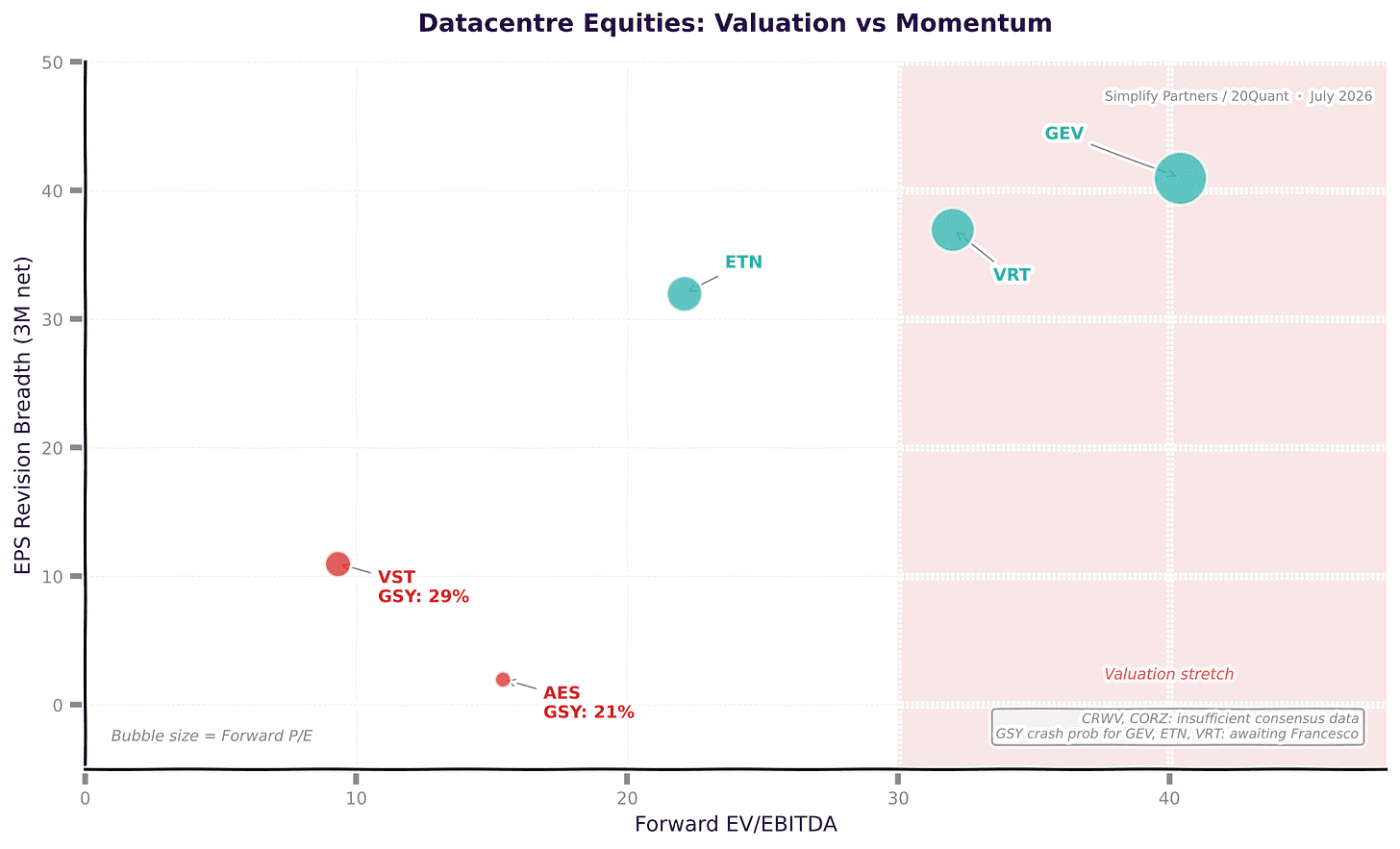
The 20Quant GSY Crash Risk Monitor is explicit about where the stretch sits. The independent power and renewable-electricity producers screen as the most extended relative to fundamentals, with names such as Vistra and AES flagged at elevated crash probabilities of roughly 29 and 21 percent. Revenue growth has not kept pace with price appreciation, and the hyperscaler pivot toward captive generation adds a structural headwind the market has not fully priced. Other datacentre-adjacent sectors have also entered the GSY screen in recent months, with readings that range from moderate to low depending on how well earnings have confirmed the price move. The full sector-level breakdown is in the latest GSY Crash Risk Monitor report.
The private and neocloud operators are a more nuanced case. CoreWeave carries a large valuation, but one anchored by a roughly $99 billion remaining-performance-obligation backlog and real capacity. The bitcoin-to-compute developers trade at premiums that are, for now, justified by a tangible structural advantage in energised land.
The instruction is to hold the technology question and the valuation question apart. Price each separately.
The permitting backlash is a real timing risk
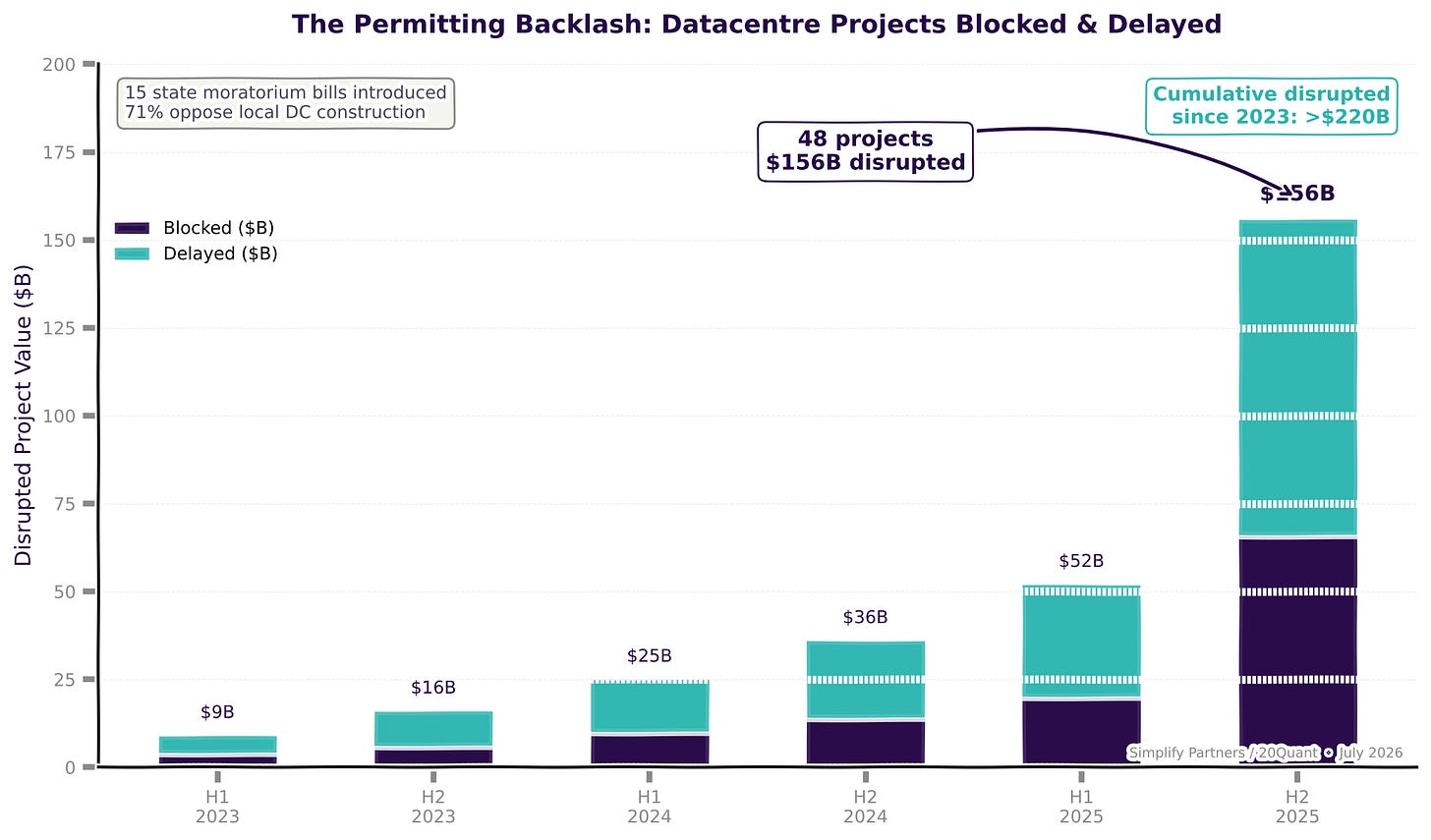
The constraint is not only physical. Public and political pushback has become a genuine execution and timing risk. Roughly 71 percent of Americans now oppose local data-centre construction, a higher opposition rate than for nuclear power plants. That friction has a measurable cost.
Dan Vermeer contextualised the backlash: between 30 and 50 percent of planned US data centre builds for 2026 are projected to be delayed or cancelled, driven by a combination of power shortages, equipment backlogs, and community opposition. Microsoft’s CEO Satya Nadella himself acknowledged publicly that there will be an overbuild.
Disrupted capital: in the second half of 2025 alone, opposition affected 48 projects worth about $156 billion, of which around $66 billion was blocked and $90 billion delayed, pushing cumulative disrupted investment since 2023 past $220 billion.
Rising cancellation rate: project cancellations and postponements recently spiked 56 percent month on month.
Legislative constraint: at least 15 state-level moratorium bills have been introduced. New York’s S9144 proposes a three-year moratorium on new permits; Maine’s LD 307 advances an 18-month halt on new centres drawing more than 20 megawatts, running to November 2027.
Energy Industry Insights from Avanza Energy tracked the geographic response: the first construction decline since 2020 was caused not by faltering demand but by the grid finally running out of capacity. Around 64 percent of the 35 gigawatt construction pipeline is migrating to secondary markets to avoid regulatory gridlock, reinforcing the pivot toward captive, behind-the-meter power. The buildout continues. Where it lands, and how fast, is now a political variable.
Positioning implications
The evidence supports a framework rather than a forecast. Three observations follow.
The clearest cases sit in the supply constraints. Custom silicon and connectivity, firm power and grid equipment, cooling, construction labour and the metals that feed them. These are where a measurable ceiling meets demand that exceeds it.
Merchant compute is necessary but commoditised. It is the headline, not the bottleneck. The margin is moving to whoever solves power and performance per watt.
The risk is the price of access. The second-order power names carry the most valuation stretch on the crash-risk work. Position for the constraint, and let the crash-risk and factor screens govern the entry price.
How 20Quant frames this
This note is a map of the theme. Turning it into positions runs through the 20Quant process rather than a view.
Structural moat assessment: the four-criterion framework qualifies which of these names hold a durable, ten-year advantage rather than a cyclical order book. Firm-power access and custom-silicon design are candidate moats; merchant assembly is not.
QVMRD factor model: ranks the qualified names on quality, value, momentum, risk and dividend, so exposure is taken at a defensible factor price rather than on narrative.
GSY Crash Risk Monitor: flags where price has outrun fundamentals, as it does now for the independent power producers, and governs sizing and timing.
Efficient-frontier model portfolios: place any datacentre exposure inside a risk-budgeted whole, not as a standalone bet.
Founded by Federico Polese, the framework is consistent analytical discipline that does not depend on any single call. This note states what the evidence indicates. It is analysis, not investment advice.