Published on Jun 23, 2026
Brexit at 10: The UK's Sovereign Premium
Federico Polese

On 23 June 2016, UK Gilts yielded 1.37% and Italian BTPs yielded 1.40%. The spread was three basis points. Investors treated the two credits as roughly equivalent in term premium, which embedded an assumption about the relative standing of the two economies that seemed uncontroversial at the time: the UK was the safe asset reference outside the euro area, Italy was the peripheral credit, and the distance between them would widen in Italy's disfavour under any scenario of stress. The referendum was expected to test Italy's institutional resilience, not Britain's.
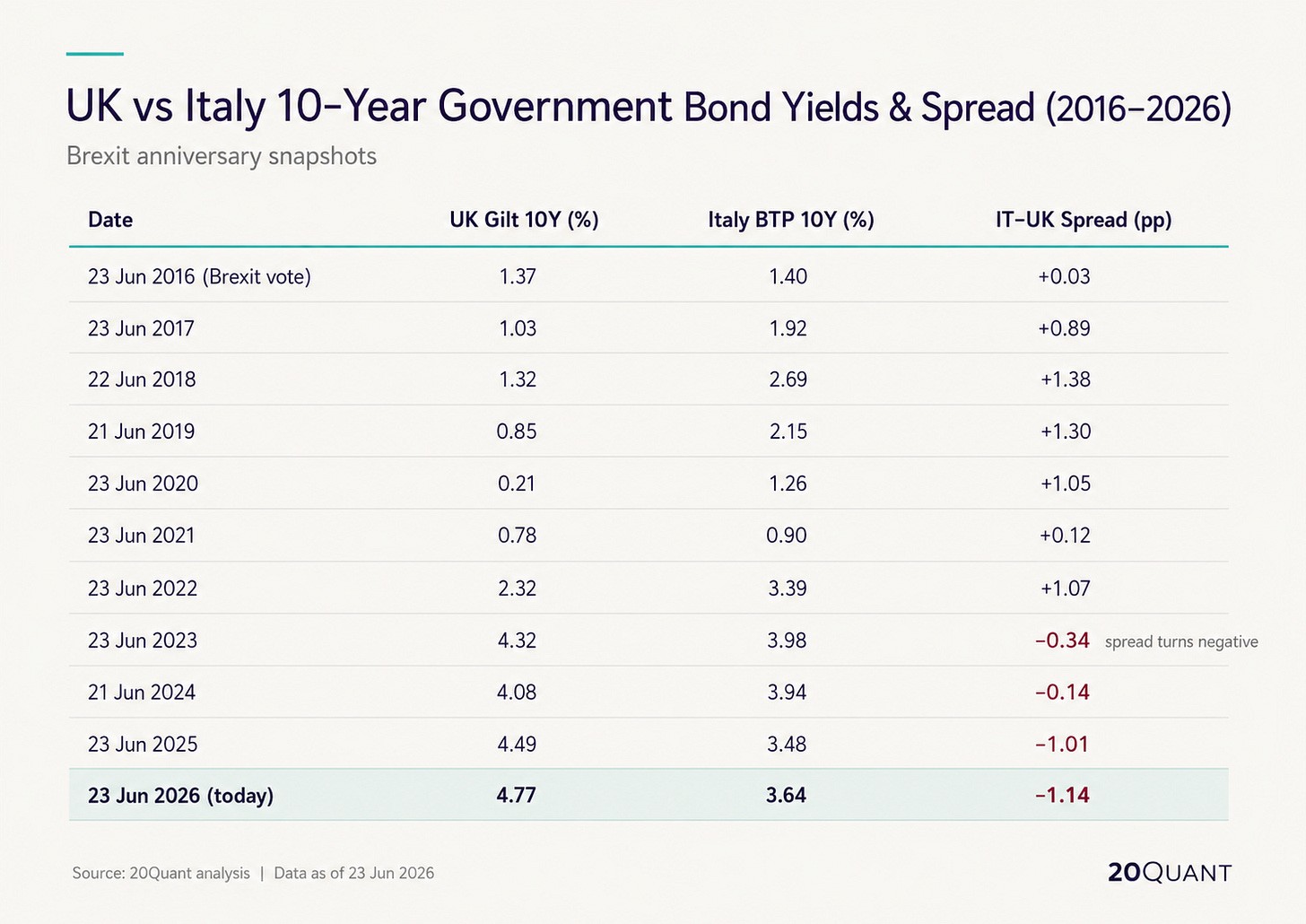
IT-UK spread = Italy BTP minus UK Gilt. Negative values indicate Gilts yielding above BTPs. Crossover begins June 2023.
Through 2017 and 2018, the old hierarchy reasserted itself. Italy’s coalition crisis and repeated confrontations with Brussels pushed BTP yields to 2.69%, leaving Gilts 138 basis points below. The market was doing what it had always done with Italian political risk, and the spread moved in the direction everyone had assigned.
The Truss mini-budget in September 2022 repriced UK fiscal sensitivity at a speed and scale that forced a structural reassessment. ECB interventions were dampening Italian peripheral spreads over the same period, and by June 2023 the two lines had crossed: UK Gilts yielding 34 basis points above BTPs. Each annual reading since has been wider. As of 23 June 2026, the inversion stands at 114 basis points, meaning the UK government pays materially more than Italy to fund its ten-year obligations.
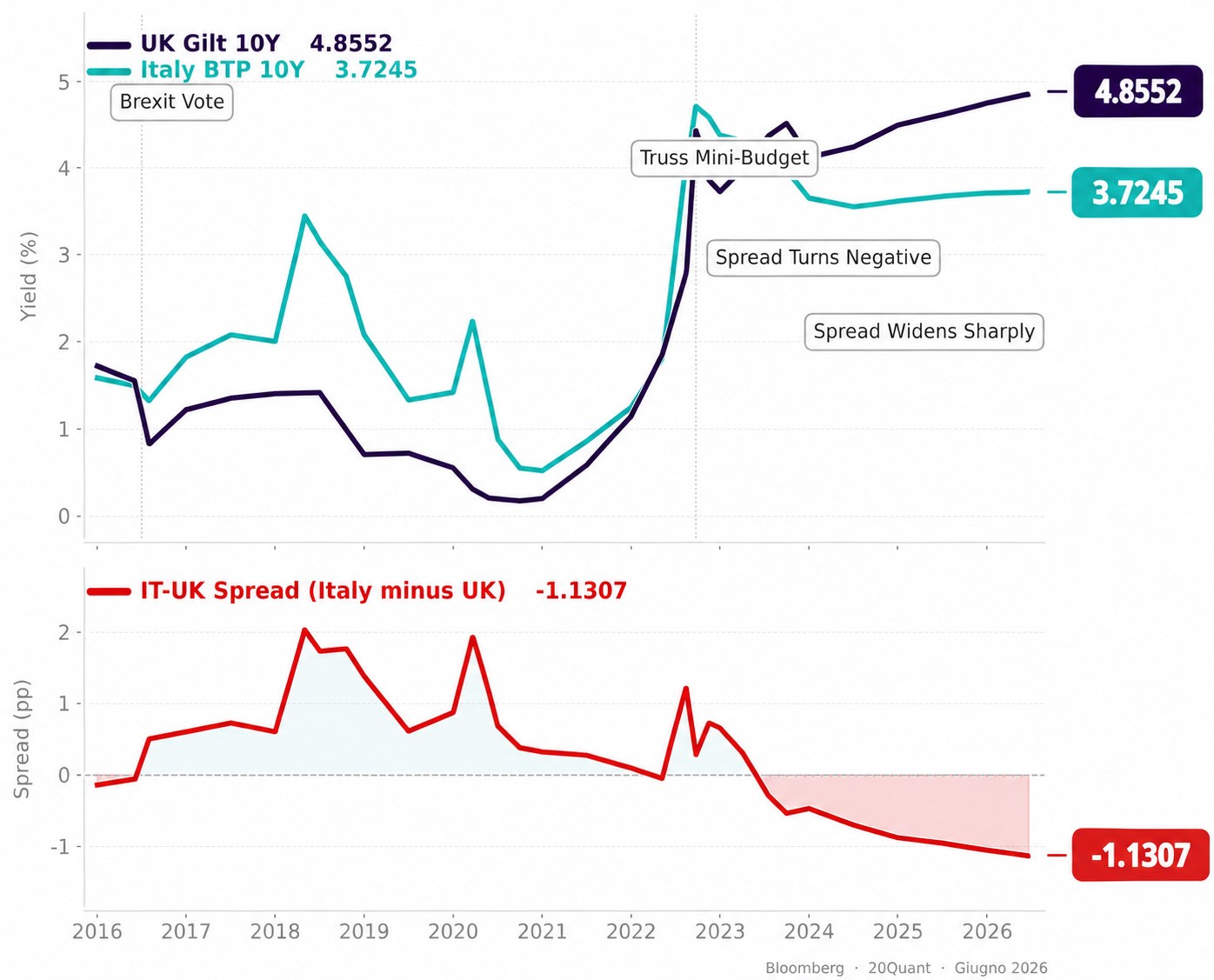
The UK side of the equation accumulated pressures across the full decade: inflation that proved more persistent than in peer economies, trend growth that disappointed relative to pre-referendum projections, a fiscal position with limited capacity to absorb external shocks, and reduced trade intensity with the economy’s largest trading partner. Brexit did not create every one of these vulnerabilities. It reduced the margin available to absorb them.
Italian sovereign debt, for its part, still carries the same structural burdens: public debt above 130% of GDP, weak trend growth, limited fiscal space. What changed is the institutional framework around it. The ECB’s PEPP commitment, the TPI backstop and broader fiscal surveillance have altered the way investors price tail risk across the eurozone periphery, and that repricing is now deeply embedded in the curve.
A correction in the spread would require credible UK fiscal consolidation, lower trade friction with the EU, and a degree of political continuity that seven prime ministers in ten years has not delivered. None of these are near-term certainties, and none would immediately restore the market structure that existed before the vote. Sovereign credibility compounds slowly and reprices fast, and the bond market’s ten-year verdict on Brexit is now legible in a single number.
To accompany this piece, we built The Gilt Comparator, an interactive dashboard that extends the article’s core question across the developed-market sovereign universe.
The chart tells the story for the UK and Italy. The dashboard lets readers test the same comparison against the US, Germany, France, Spain, Japan, Switzerland and other major sovereign markets.