Published on Jun 27, 2026
Corporate Hybrids: Where Complexity Still Pays
Federico Polese

Cash in euro earns 2.2 to 2.5 percent. Senior investment grade corporate bonds at two to three year maturities offer approximately 3.0 percent. Hybrid instruments from the same issuers, callable in the same window, offer 3.7 to 4.1 percent. The question is not bonds versus equities. The question is whether defensive capital should sit at 2.3 percent or at 3.8 percent for broadly similar issuer exposure over the relevant call horizon.
A corporate hybrid is a subordinated perpetual note, callable at dates set at issuance. Rating agencies assign 50 percent equity credit. When the call assumption is valid, the instrument behaves like medium-term fixed income rather than true perpetual risk. For issuers rated A- or above, the economics of non-call (step-up cost, market access impairment, equity credit withdrawal) make extension irrational in all but the most severe dislocations.
The 80 to 100 basis point pickup over senior bonds from the same issuer does not reflect proportionate incremental credit risk. The probability of a credit event affecting subordinated holders within three years is remote for issuers of this quality. The premium is structural and derives from three demand-side constraints permanent in the European market architecture. ESG exclusions remove energy and tobacco issuers from the buyer base on non-credit grounds. Investment grade mandate rating floors exclude instruments rated BBB, regardless of issuer quality, because hybrids are notched two levels below the senior rating. And a complexity discount of 20 to 40 basis points compensates institutional investors for pricing a non-standard structure. Investors without these constraints can seek to capture all three premiums simultaneously.
Screening
The investable universe was defined through a Bloomberg SRCH, narrowing from the full global bond universe to a final list of eight bonds across six issuers.
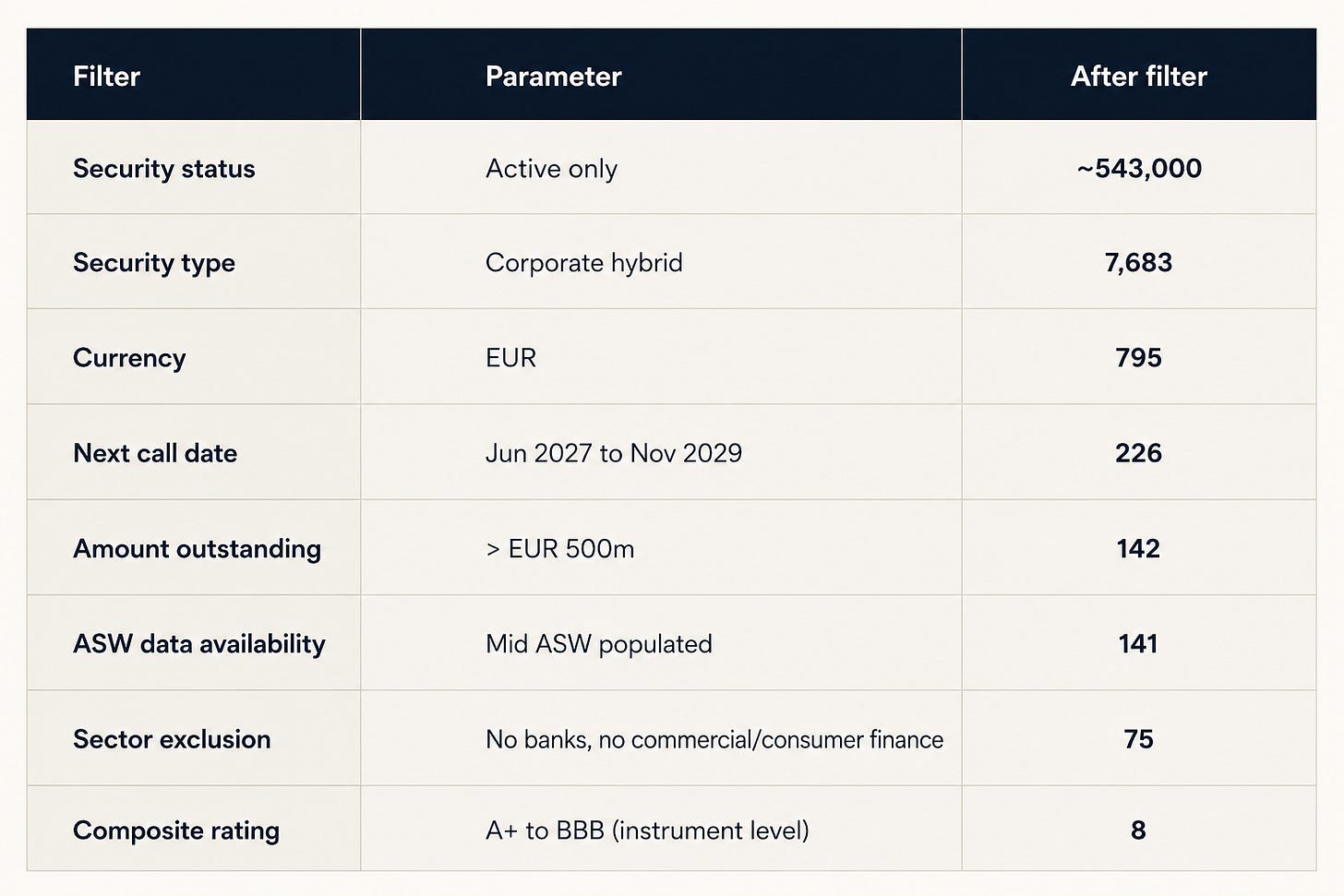
Financial hybrids (AT1, Tier 2) are excluded: mandatory loss absorption at the point of non-viability makes them inappropriate for a capital-preservation sleeve.
Bonds were ranked by ASW (mid, descending) and validated on OAS/OAD efficiency: spread earned per year of rate sensitivity. A 2027-call bond at 97 basis points ASW over 1.3 years of OAD earns approximately 75 basis points per year. A 2029-call bond at 115 basis points over 2.7 years earns approximately 43. The raw spread suggests the longer bond is cheaper. The efficiency metric shows the opposite. All bonds in the final selection carry BVAL scores of 8 or above, confirming executable pricing.
Risks
Non-call produces a 5 to 10 point mark-to-market loss and extends duration from two to three years to ten or more. The scenario requires a severe dislocation preventing hybrid refinancing. A- to A+ issuers face market closure last in any stress. Italian corporate hybrids widen with BTP spreads during sovereign stress, a technical correlation that diminishes as the call date approaches. Rate risk is the smallest component: OAD below three years limits the impact of a 100 basis point shift to less than 3 percent of sleeve value.
How we applied it
The sleeve delivers a weighted average YTC of approximately 3.8 percent against approximately 3.0 percent for equivalent senior bonds. Effective duration is approximately 2.6 years. Staggered call dates produce annual capital recycling events where the decision is to reinvest in fixed income or redeploy into equities. All four positions carry BVAL scores of 8 to 10 and can be liquidated within two settlement cycles.
To see the exact securities selected, the issuer-level rationale and the full implementation note, visit our website.