Published on Jun 22, 2026
The Stress Test That Already Happened
Federico Polese

When Timothy Geithner published Stress Test in the aftermath of the 2008 global financial crisis, the book’s central lesson was not about the crisis itself. It was about the painful, belated recognition by regulators that the system they were supposed to oversee had mutated beyond their understanding. Geithner described arriving at the New York Fed and discovering that the risks everyone assumed were dispersed and contained were in fact concentrated, opaque, and deeply interconnected.
Nearly two decades later, a new chapter of that story is writing itself. The Bank of England has just launched the first-ever coordinated, regulator-led stress test of the private markets industry, modelling a scenario that includes 7% interest rates, a 30% UK equity collapse, and a complete credit freeze. Forty-six firms, including Apollo, Blackstone, KKR, and Ares, have agreed to participate. The European Central Bank, meanwhile, has doubled the number of traditional banks it is probing for hidden, overlapping exposures to private credit funds.
The Geithner parallel is uncomfortably precise. In 2007, regulators were only beginning to grasp that subprime mortgage risk had migrated from bank balance sheets into opaque securitisation vehicles that nobody was stress-testing. Today, an estimated $1.8 trillion to $2.5 trillion of corporate lending has migrated from regulated banks into private credit funds, vehicles that, until this week, had never been subjected to a coordinated systemic stress test at scale.
But you don’t need to wait for the regulators’ results to see the stress. A glaring divergence is flashing in the credit markets, and an increasing number of funds are pulling up the drawbridge on the very retail investors who fuelled their explosive growth.
The Divergence: When the Same Borrowers Price Differently
If you are looking for the canary in the coal mine, look at the widening spread between public high-yield (HY) bonds and illiquid leveraged loans.
Leveraged loans and HY bonds are not interchangeable instruments: loans sit higher in the capital structure, are senior secured, and carry floating rates. But they often finance the exact same underlying companies. A mid-market software firm might have a leveraged loan held by a private credit fund and a high-yield bond trading on a public exchange, both reflecting the same fundamental business risk.
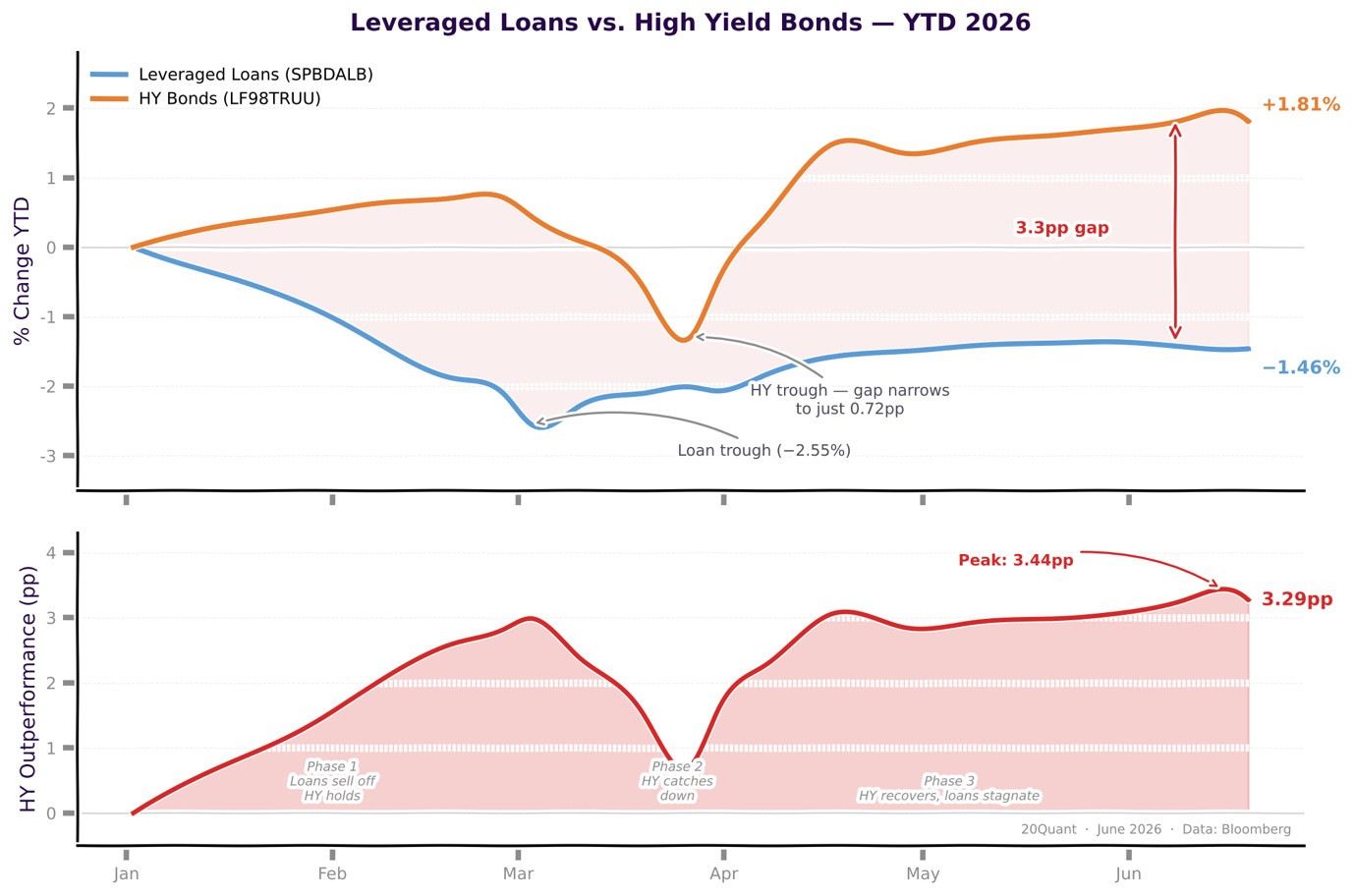
Despite this shared borrower universe, the two markets have diverged sharply. As of mid-June, leveraged loans were down roughly 1.5% for the year, while HY bonds were up about 1.8%, a 3.3 percentage point performance gap, the widest of the entire year. The gap peaked at 3.44 percentage points on June 15 and has not meaningfully closed.
This persistent divergence implies that the illiquid loan market is pricing in structural liquidity risks like redemption gates and forced selling by funds under pressure that the daily-traded HY bond market is not. The gap cannot be explained by differences in credit quality, because the underlying borrowers are often identical. It can only be explained by the structure of who holds these assets and how easily they can exit.
The divergence has moved through three distinct phases this year. From January through early March, loans sold off while HY bonds held steady. This was the private credit contagion phase, driven by redemption gate headlines. In late March, a broad tariff-driven risk-off move briefly dragged HY down too, compressing the gap to just 0.72 percentage points. It was the one moment the two markets moved in sync. Since April, HY has rallied sharply back to positive territory while loans have stagnated, re-opening the gap to record levels. That third phase is the most analytically significant: the market is treating leveraged loans as structurally impaired, not just cyclically weak.
Here is the number that should frame the entire debate. The BOE’s stress scenario assumes a 400 basis-point widening in leveraged loan spreads, a shock that translates, roughly, to a price decline of about 4.0 points on a par loan. The S&P/LSTA Leveraged Loan Price Index (SPBDALB) opened the year at 96.64. At its March 3 trough, it had fallen to 94.17, a move roughly two-thirds of the way toward the magnitude of shock the BOE is modelling, without a single formal credit event, purely on tariff fears, redemption gate headlines, and risk-off positioning. The market stress-tested itself in under ten weeks. The BOE is not modelling a fantasy. It is modelling an amplification of conditions that partially materialised in Q1.
The Equity Early-Warning System: BDCs Are Already There
There is a more granular, real-time signal of private credit stress, and it has been flashing for months.
Business Development Companies, or BDCs, are publicly listed vehicles that lend directly to mid-market companies using the same leveraged loan instruments that private credit funds hold. Unlike private funds, which report net asset values quarterly on a self-assessed basis, BDC shares trade daily on the stock exchange and are marked by the market in real time. They are, in effect, the equity wrapper around the illiquid loan portfolios that private credit managers would prefer you valued on their terms, not the market’s.
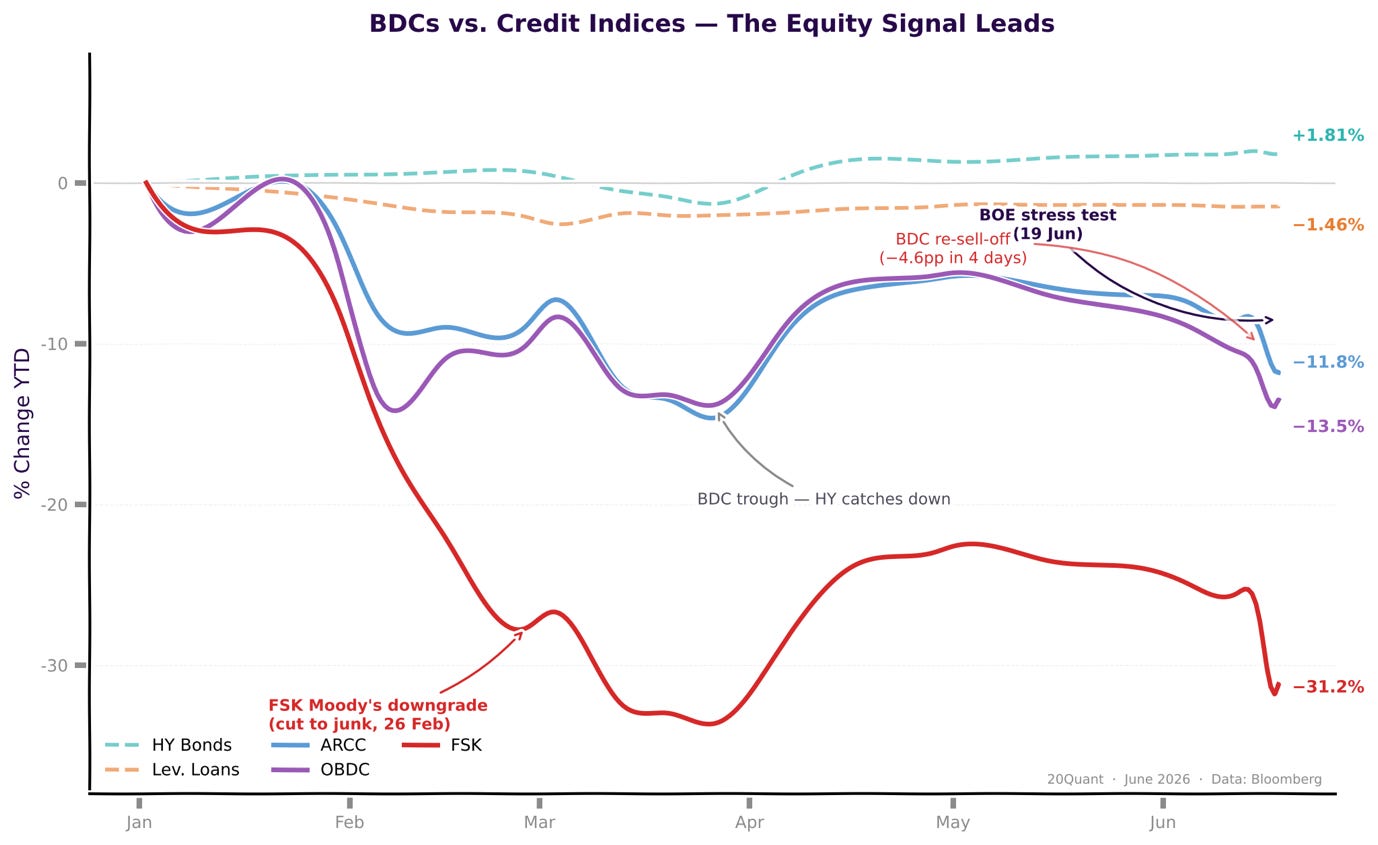
The BDC signal has been unambiguous. By late January, when the leveraged loan index had barely moved, BDC equities were already down 5%. By early February, the average BDC was down nearly 12% while loans had fallen only 1.3%. BDC equity prices led the loan index lower by three to five weeks. That makes mechanical sense, since BDC shares clear instantly while secondary loan prices report with a lag.
Among the major BDCs, the picture ranges from stressed to distressed. Ares Capital (ARCC), widely regarded as the highest-quality name in the sector, is down roughly 12% for the year and trades at 0.92x book value. Blue Owl Capital Corp (OBDC) is down about 13.5% and trades at 0.75x book. The outlier is FS KKR Capital Corp (FSK), which was cut to junk by Moody’s in late February and subsequently received a $300 million preferred equity injection from KKR. It is down 31% for the year and trades at just 0.54x book value. FSK’s decline is partially idiosyncratic, driven by its own credit event rather than the broader market, but it serves as a warning of what happens when the mark-to-model facade cracks on a specific vehicle.
The most analytically important signal came in mid-June: between June 12 and June 18, just four trading days, the BDC basket fell 4.6 percentage points while the leveraged loan index barely moved and HY bonds were flat. BDC equities are pricing in something the secondary loan market has not yet reflected: either forced NAV remarking ahead of Q2 reporting, or anticipation of further redemption gates. If you want to see where the loan market is headed, look at where BDC equities have already been.
The “Gating” Phenomenon: Trapping the Retail Investor
This structural risk is not theoretical; it is actively trapping investors. Over the past year, the industry has experienced a cascade of “gating” events: where funds suspend or strictly limit investor redemptions.
BlackRock had to cap withdrawals on its massive $26 billion HLEND private credit fund at 5% after client redemption requests spiked to 9.3% in one quarter, and then surged again to 13.3% in the next. Apollo’s $25 billion Debt Solutions fund saw investors request 11.2% of their capital; they received 5%, forty-five cents on the dollar. Ares, Cliffwater, and Partners Group have all enforced similar limits on their semi-liquid funds. Partners Group went further, publicly warning that additional gates may be imposed on other funds in its platform.
Apollo’s co-president defended redemption caps as “a feature, not a bug”: the structural mechanics, he argued, are working exactly as designed. That framing is revealing. The funds were marketed to retail investors on the promise of quarterly liquidity: put your money in, earn a premium yield, and withdraw every three months. The reality is that when too many investors want out at once, and “too many” turns out to mean anything above 5%, the fund locks the door. The quarterly liquidity was never a commitment. It was a best-efforts aspiration, contingent on nobody actually needing it at scale.
This wave of redemption caps exposes what the Bank of England identifies as “liquidity transformation risk”: a fundamental, structural mismatch between the quarterly liquidity promised to retail investors and the multi-year illiquidity of the underlying corporate loans these funds hold. When fear sets in, the danger is that gates beget gates: investors in ungated funds pre-emptively rush for the exits to avoid getting trapped, triggering precisely the systemic liquidity freeze that no individual fund can withstand alone.
“Like Fish”: Unsuitable for Mom and Pop
If you want to understand how the industry really views the retail investors who now provide a meaningful share of its capital, consider the words of Monroe Capital’s CEO, who dismissed retail investor panic by saying: “Retail investors are like fish. They swim in schools, they all come in together and they all tend to go out together.”
That one sentence tells you everything you need to know about the suitability question. The industry simultaneously courts retail capital, aggressively marketing complex, illiquid loans as stable yield products, and then expresses contempt when those same investors behave like retail investors, which is to say, like people who expect access to their own money.
Shifting risky corporate debt away from the traditional banking sector and into the hands of private investors can be healthy for the broader economy. Banks are better capitalised when they are not warehousing leveraged loans on their balance sheets. But this transfer only works if the end investors genuinely understand that they cannot simply demand their money back whenever they want. The mis-selling risk is real: everyday investors need proper guardrails and clear, enforceable disclosure before they are marketed illiquid corporate loans dressed up as a savings account with a higher yield.
What Happens Next
The regulatory response will be procedural, not interventionist. The BOE stress test is exploratory by design. There are no binding capital requirements, no forced asset sales, and no regulatory deadline. The results are not expected until late 2026. If the risk stays contained, the regulators will review prospectus disclosure and investor suitability, not impose structural reform. This is Geithner’s lesson in reverse: the system gets examined, but only after the architecture has already been built.
If the risk remains non-systemic, the dislocation becomes an investment opportunity. The smart money is already positioning. Blackstone raised $10 billion for its opportunistic credit fund at hard cap in April. Oaktree is deploying into dislocated loans. Oaktree’s Strategic Credit Fund reported that Q2 redemption requests fell to 4.5%, down from 8.5% in Q1, suggesting the worst of the retail exodus may be easing at the margin. If the gating cycle stabilises and forced selling creates mispricing without contagion to the banking system, this is textbook distressed alpha. BDCs trading at 0.54x to 0.92x book value are either pricing in a credit catastrophe or offering a generational entry point. The divergence between HY bonds and leveraged loans either closes from below, as loan prices recover, or from above, as both converge on fair value. For institutional capital with a multi-year horizon and no liquidity constraints, the current stress is precisely the environment they raise funds to exploit.
But there is a third layer. Can private investors, particularly retail, actually tolerate the illiquidity, the NAV uncertainty, and the psychological pressure of watching BDC proxies fall 12 to 31 percent while their own fund quotes a stable net asset value once a quarter? The answer to that question is the transmission mechanism between a contained dislocation and a systemic event. If retail investors accept that gating is a temporary liquidity management tool and wait for their underlying loans to mature, the cycle exhausts itself. If they cannot, if the gap between the market signal and the reported NAV erodes their trust, if gates beget gates, if the behavioural panic becomes the credit event, then the non-systemic risk becomes systemic.
When the market flashes structural distress, it becomes a “live stress test” and the question is whether the regulators arrive in time, or whether, as Geithner learned the hard way, they are already too late.