Published on Apr 3, 2026
Prediction Markets: The Architecture of Asymmetric Information
Federico Polese
Executive Summary
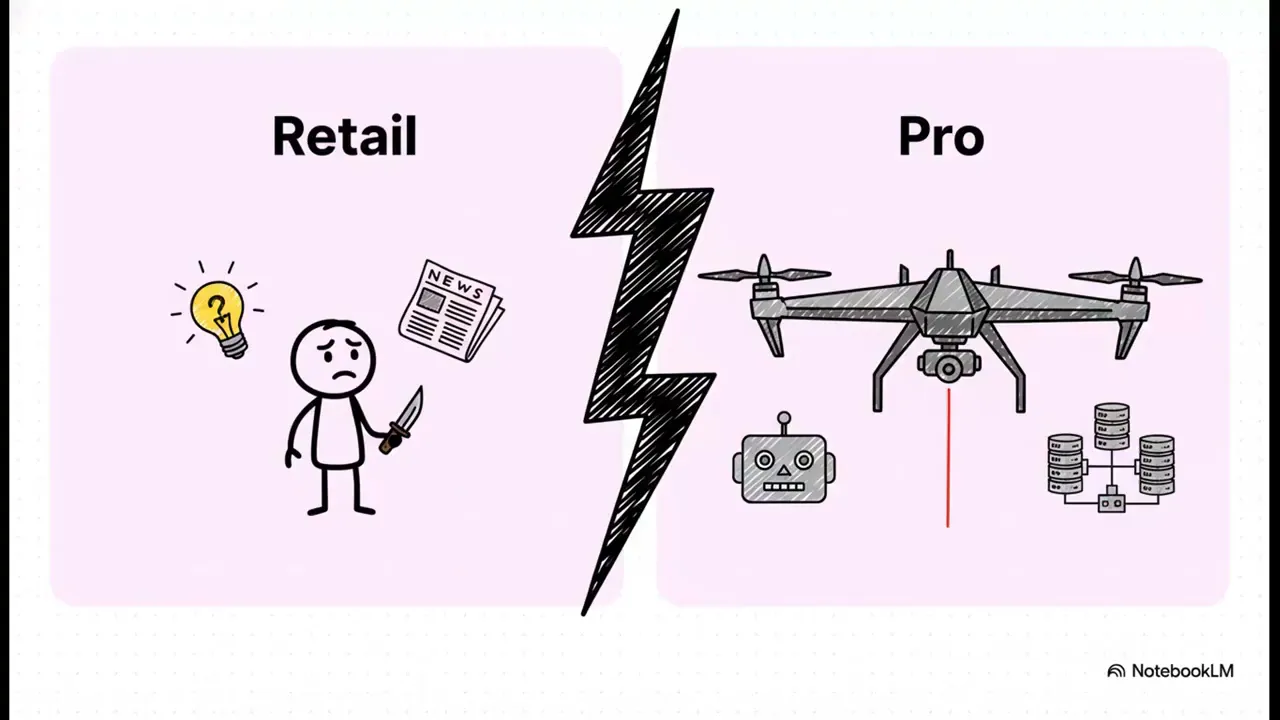
Prediction markets are structurally equivalent to zero-sum games: the retail segment provides liquidity that sophisticated participants — institutional trading desks, AI agents, and market makers — systematically extract.
Profit concentration on Polymarket is extreme: 740 accounts hold more than two-thirds of all realised gains across a platform with over 2 million active wallets.
Insider trading risk is no longer theoretical. Price behaviour in the February 2026 Iran attack market exhibited a pattern inconsistent with public information flow, raising regulatory concern at the CFTC.
Automation has industrialised counter-retail strategies. Latency arbitrage, tail-betting, and systematic counter-trading of low-performing accounts are now standard tools for professional participants.
For disciplined investors, prediction markets offer a useful signal-extraction layer, not an investable asset class.
The Market Structure Is Not What It Appears
Prediction platforms present themselves as decentralised information aggregators. The economic reality is more precise: they are mechanisms for transferring probability-weighted capital from uninformed to informed participants.
The data from Dune Analytics is unambiguous. Among approximately 2.23 million Polymarket wallets, 58% to 70% are in loss. The median losing wallet has absorbed a USD 94 drawdown. Against this, just 740 accounts — 0.037% of the user base — hold USD 15.2 billion in realised profits, representing more than two-thirds of all money won on the platform (Keyrock, 2025–2026). The distribution is not skewed. It is bifurcated.
The chart above makes this visible at the category level: the gap between what a typical profitable wallet earns (the median) and what the average implies — inflated by dominant accounts — spans two orders of magnitude in high-volume categories such as Crypto (median USD 105 vs. average USD 3,755) and Politics (median USD 130 vs. average USD 3,469).
The second visualisation is more diagnostic. Wallets earning over USD 1,000 represent 11.8% of all accounts yet capture 97.6% of total realised profits. The remaining 88% of accounts split the residual 2.4%. This is not a market where edge is distributable. It concentrates by design.
Automation Has Changed the Competitive Landscape
The population of sophisticated participants is not static. It is growing, and it is increasingly non-human.
Professional trading firms including DRW and Susquehanna have hired dedicated prediction market traders at salaries exceeding USD 200,000 per annum. Their mandates: detect pricing inefficiencies, monitor unusual activity, and exploit cross-platform arbitrage. The strategy known as latency arbitrage exploits the fractional delay between Polymarket’s price updates and the underlying crypto exchange prices that drive resolution probabilities. Analytics platforms such as PredictionHunt now package cross-market arbitrage opportunities — finding scenarios where “Yes” on Kalshi and “No” on Polymarket for the same event combine to near risk-free profit.
One platform, Stand, has taken counter-retail trading to its logical extreme: an automated tool that identifies consistently loss-making wallets and systematically bets against their positions. The “dumb money at the tails” strategy — targeting casual bettors placing long-shot wagers at stretched odds — has been formalised into a product.
These are not novel dynamics. They mirror the evolution of equity markets, where retail order flow was first identified as exploitable, then intermediated, then fully automated. The difference is that prediction markets compress this cycle. The infrastructure is lighter, the regulatory framework less developed, and the retail-to-professional ratio is currently wide enough to sustain high extraction rates.
Insider Trading: A Structural Vulnerability
The third chart above illustrates the most material systemic risk in prediction markets today. In the hours preceding the US attack on Iran on February 28, 2026, implied probability on the February 28 deadline contract spiked from approximately 7% to over 25% — more than 40 hours before the event, and at a time when all preceding deadline contracts remained flat at 3%–5%.
This price action is inconsistent with public information. The contracts for February 25, 26, and 27 show no corresponding movement, which rules out a generalised market reassessment. What is visible in the data is a concentrated bet on a specific date, placed well in advance, by wallets that were largely newly opened. The CFTC has been notified.
This is not an isolated incident. Suspiciously-timed positions on Polymarket preceded the announced capture of Nicolás Maduro by a similar margin. Both cases illustrate a structural problem: prediction markets, by offering leveraged, binary bets on geopolitical events, create direct financial incentives for the misuse of sensitive information. The closer prediction platforms move toward mainstream financial markets, the more acutely this conflict will require resolution.
Platforms are responding. Identity verification, internal suspicious-activity flagging, and mandatory trade reporting to the CFTC have been introduced. These are necessary but not sufficient. The asymmetry of information in binary event markets is, by definition, maximally exploitable: the insider who knows the outcome holds a contract that pays out 100 cents on the dollar.
The Signal, Not the Speculation
The relevant question for institutional investors is not whether to bet on prediction markets. It is whether the price signals they generate carry information useful for portfolio positioning.
On this narrower question, the evidence is more constructive. Prediction market prices have demonstrated superior accuracy in aggregating distributed information on electoral outcomes, macroeconomic data releases, and central bank decisions relative to polling and consensus surveys. This is precisely because they impose a financial cost on expressing a view — a mechanism that filters noise from signal, provided the participant pool is sufficiently large and diverse.
At 20Quant, the analytical framework developed by Federico Polese incorporates probability distributions and regime signals as inputs to positioning decisions. Prediction market-implied probabilities — stripped of the noise introduced by retail participation — offer a complementary data layer, particularly for event-driven positioning around geopolitical and policy catalysts. The models treat these as one signal among many, not as a primary input. Discipline in sourcing does not differ from discipline in any other data layer: the question is always whether the signal survives aggregation into a regime-aware framework.
The analogy to poker is apt. Skilled, volume-disciplined players with robust bankroll management can generate positive expected value. Casual participants cannot. The difference is not luck. It is the systematic application of edge across a sufficient number of independent events, under conditions where the competition is understood and priced. Prediction markets currently fail the second condition for most retail participants: the competition is neither understood nor priced.
Strategic Conclusions
The prediction market sector is undergoing the same professionalisation cycle that characterised derivatives markets in the 1980s and algorithmic equity trading in the 2000s. The current window — high retail participation, developing regulatory framework, nascent automation — is the period of maximum extraction for sophisticated participants.
For the institutional investor, three observations follow. First, prediction market-implied probabilities merit monitoring as a real-time signal on discrete events, with appropriate discounting for the insider-trading distortion documented above. Second, direct participation without material informational edge and systematic automation is a negative expected value proposition. Third, the regulatory trajectory — CFTC reporting, identity verification, anti-manipulation rules modelled on equity exchanges — will progressively compress the arbitrage opportunities currently available and narrow the gap between retail and professional participants. The market will mature. The question is at what cost to those funding the transition.
If you would like us to stress-test this against your allocation, reply to this note.
Wishing you the best.
This newsletter is the intellectual property of 20Quant.
Subscribe to more research at 20quant.eu