Published on Apr 29, 2026
THE GREAT FRAGMENTATION
Federico Polese

The market is wrong about the risk.
Financial markets are pricing the Middle East conflict and the tariff escalation as if they were cyclical bumps. A quarter of disruption, maybe two, and then a return to normal. That reading is complacent, and the reason it is complacent has nothing to do with geopolitics being unpredictable. It has to do with the type of shock we are dealing with.
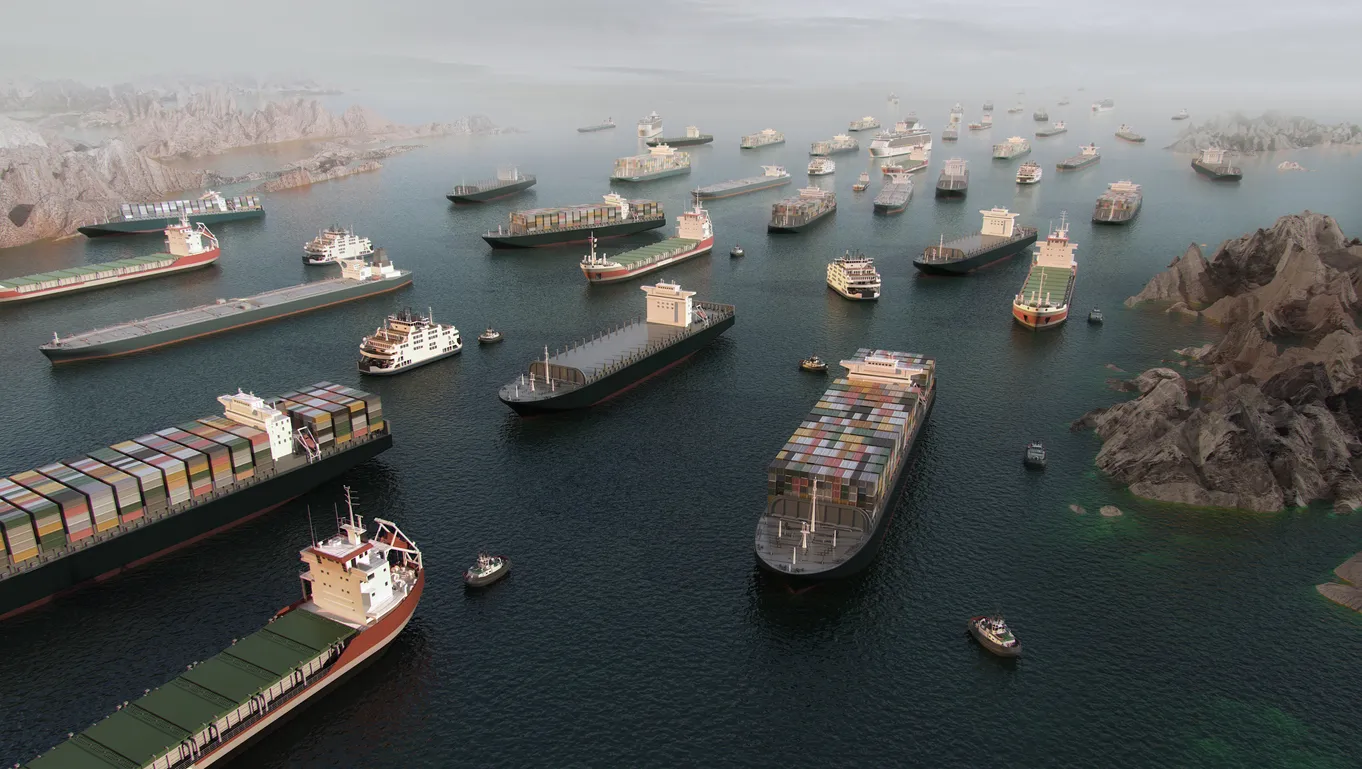
This is not a demand problem. It is a physical scarcity problem. When supply chains break because a critical input simply is not available, the damage does not escalates linearly. The 1970s taught this lesson clearly: embargoes, rationing, and sustained disorganisation in commodity markets produced inflationary regimes that central banks struggled to contain for a decade. Markets today are still structured around demand-side models even after Covid-19. They are poorly equipped to price what happens when the constraint is physical.
Consider helium. Qatar supplies a dominant share of global production. Helium is not a niche commodity. It is essential to semiconductor fabrication. A prolonged disruption in the Gulf does not create a temporary bottleneck in chip supply. It threatens to shut down productions. This is not a hypothetical scenario parked in the tail of a distribution. It is a live exposure that markets are choosing to ignore.
Inflation is splitting across the Atlantic, and that matters more than the headline numbers.
The US and Europe are both dealing with inflation, but the underlying mechanics are different, and that divergence is going to force different policy responses.
In the United States, the problem is domestic. Demand is running hot. A significant part of the reason is fiscal: the scale of government spending, most recently through the Big Beautiful Bill, is keeping the economy overheated in a way that monetary policy alone cannot easily offset. The Fed finds itself in an uncomfortable spot. It needs to cool things down, but the federal government keeps turning up the heat. April 29 statement confirms the Committee is holding rates at 3½–3¾%, but the vote split is unusually wide: one dissenter wanted a cut, while three others opposed even a mild easing bias in the language. That is not consensus. It is a Committee under pressure from opposite directions.
Europe has the opposite problem. Eurozone inflation hit 2.5% year-on-year in March, and the driver was energy. A 6.8% monthly surge in energy costs is an imported shock, the kind of inflation that monetary policy is least well suited to address. Notably, the
Fed's own statement on April 29 cited global energy prices as a driver of US inflation — confirming that this is not a European problem. It is a transatlantic one. The risk is that this supply shock converts into a demand shock as Chairman Powel said.
The ECB may be forced to hike to prevent the energy spike from embedding itself in wages and price expectations. Raising rates into a weakening economy to fight inflation that originated abroad: that is the defining dilemma of the 1970s, and Europe is walking straight into it.
The EU-Bond debate is really a debate about what Europe wants to become.
If Europe is going to respond to geopolitical fragmentation as a bloc rather than as a collection of national governments acting alone, it needs shared fiscal instruments. That is the argument Draghi and others are making when they call for pragmatic federalism. The internal vetoes, Hungary and Slovakia being the most visible examples, are not going away on their own. Either the governance structure adapts, or the bloc remains paralysed on the issues where collective action matters most.
The centrepiece of that argument is common debt. Jointly and severally guaranteed EU-Bonds.
The opposition to this is not irrational. France's debt dynamics have worsened materially. Germany recently used accounting structures to work around its own constitutional borrowing limits. If two of the largest economies in the union are already stretching their fiscal frameworks, critics have a legitimate question: what happens when common debt removes the last layer of fiscal discipline?
On the other side, the argument is about urgency. Europe needs to finance military rearmament and a complete overhaul of its energy infrastructure. Neither objective can be funded through incremental adjustments to national budgets, especially in the current political environment. And there is a structural upside: a deep, liquid market for EU-Bonds would create a global safe asset in euros, something that currently does not exist at the scale needed to rival the US Treasury market.
This is a genuine trade-off with measurable costs on both sides. The analytical discipline is in separating the financial argument from the political one, which is harder than it sounds because they are deeply entangled.
Political trust is fraying inside the member states.
These macro and institutional pressures do not exist in a vacuum. They land in domestic political environments that are already polarised and distrustful. The recent Italian referendum is a useful illustration. Voters rejected a constitutional measure to separate
judicial and prosecutorial careers. Whatever the legal merits of the reform, the result was driven by a widespread suspicion that the real purpose was to expand executive influence over the judiciary.
This matters for markets because structural reform in Europe, the kind that unlocks fiscal credibility or qualifies a country for access to common instruments, requires domestic political capital. When that capital is depleted by culture-war battles and institutional distrust, the reform pipeline slows down. And when reform slows, the gap between what Europe needs to do and what it is actually capable of doing widens. That gap is already visible.
What this means for portfolios.
The regime has shifted. Three adjustments follow.
The first is to stop waiting for normalisation. Central banks on both sides of the Atlantic are constrained in ways that prevent orthodox policy responses. The Fed cannot tighten freely because fiscal policy is working against it. The ECB cannot ease freely because imported inflation forces it to maintain a hawkish stance even as growth deteriorates. Any framework that assumes a smooth path back to target inflation is mispricing the current environment.
The second is to take physical supply chain exposure seriously. Not as a thematic overlay, but as a measurable risk factor. Gas, helium, semiconductors, battery metals: these are inputs where scarcity can produce sudden, non-linear effects on sectors that appear to have no direct connection to the Middle East or to trade policy. The indirect exposure is where the surprise sits.
The third is to treat the US-Europe divergence as a structural feature, not a temporary dislocation. Dollar assets and euro assets are responding to fundamentally different macro drivers right now. That asymmetry needs to show up in positioning explicitly. Passive diversification will not capture it.
The regime has changed. Positioning needs to reflect that.
20Quant. The architecture of disciplined investing.